
Table of Contents
ToggleWhy BOPP Woven Laminated Bags Are Redefining Industrial Packaging in India
BOPP Woven Laminated Bags have emerged as one of the most critical packaging innovations for Indian manufacturers and exporters in 2026. As India’s packaging industry crosses the ₹4.5 lakh crore mark this year — growing at a CAGR of 11.2% according to the Indian Institute of Packaging (IIP) 2026 Annual Report — the demand for high-performance, cost-effective, and visually superior bags has never been higher.
Whether you’re a rice exporter in Punjab, a chemical manufacturer in Gujarat, or a building materials distributor in Maharashtra, the right packaging defines your brand’s first impression. BOPP Laminated Woven Bags from Aeroflex Neu offer precisely that — the strength of woven polypropylene combined with the print clarity and moisture resistance of Biaxially Oriented Polypropylene (BOPP) film.
At Aeroflex Neu, we manufacture BOPP Woven Laminated Bags that serve India’s most demanding industries — from agriculture and food processing to cement, chemicals, and retail — with a reliability that meets both BIS standards and international export compliance requirements.
What Are BOPP Woven Laminated Bags?
What makes BOPP different from regular PP woven bags?
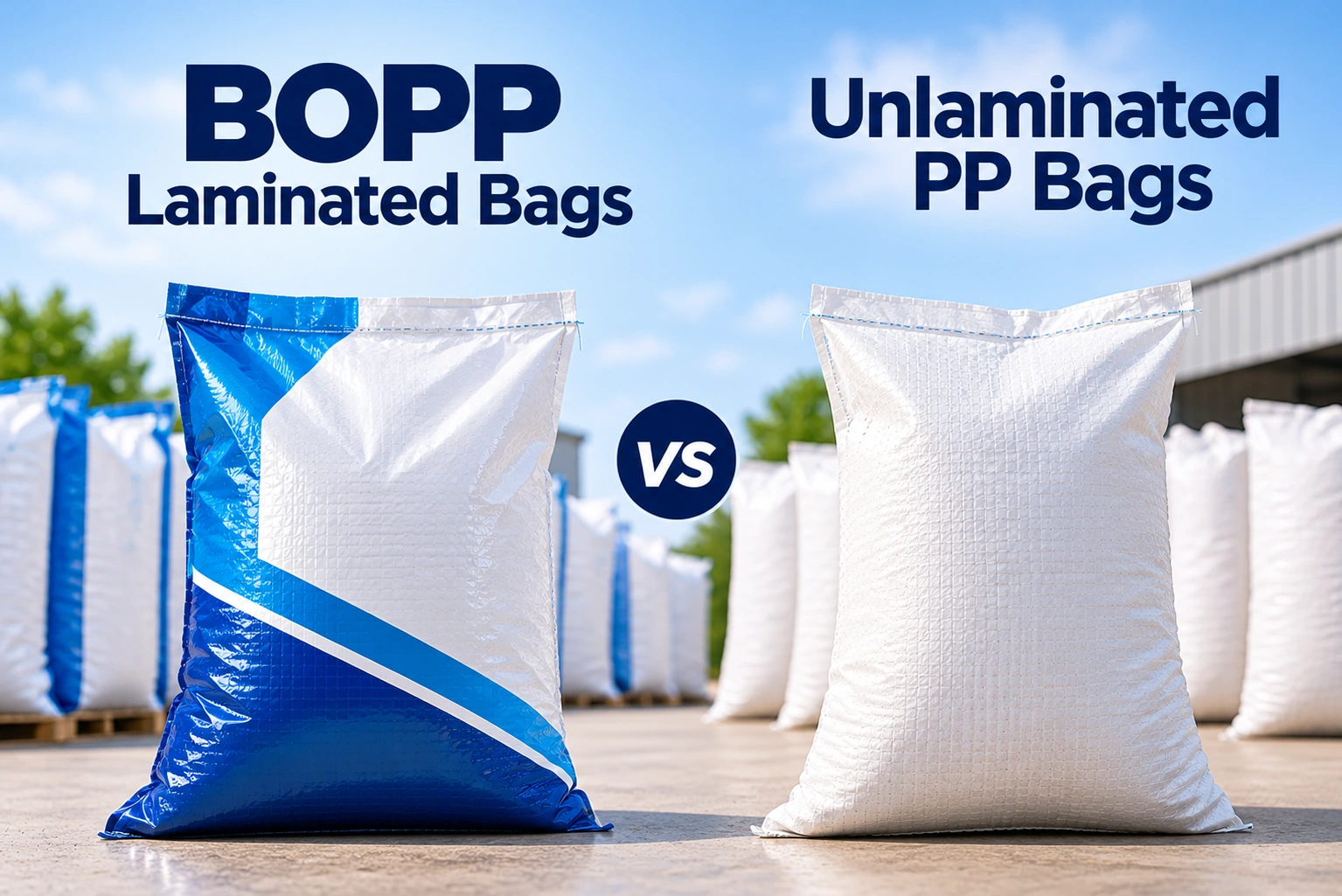
BOPP Woven Laminated Bags are constructed by fusing a BOPP film layer onto a base of woven polypropylene fabric. This lamination process creates a bag that combines two distinct advantages: the structural tensile strength of the woven PP substrate and the glossy, printable, and moisture-resistant surface of BOPP film.
Regular PP woven bags are strong but have a matte, coarse finish with limited print quality. BOPP laminated bags, by contrast, allow high-definition flexographic or rotogravure printing with up to 8 colours, making them ideal for retail-facing products and branded exports.
Key structural components of a BOPP Woven Laminated Bag:
- Woven PP fabric base (80–120 GSM depending on application)
- BOPP film layer (15–25 microns) laminated via heat or adhesive bonding
- Optional inner liner (for food-grade or moisture-sensitive goods)
- HDPE or PP tape reinforcement at seams and handles
What Are the Key Features of BOPP Woven Laminated Bags?
How do BOPP Woven Laminated Bags perform in Indian climate conditions?
India’s diverse climate — from the humid coastlines of Kerala to the dry heat of Rajasthan — puts packaging under serious stress. BOPP Woven Laminated Bags are engineered to withstand these extremes.
Core features that make them ideal for Indian conditions:
- High tensile strength: Handles loads from 5 kg to 100 kg without seam failure
- Moisture resistance: The BOPP lamination layer blocks ambient humidity, protecting food grains, fertilisers, and chemicals
- UV stabilisation: Prevents colour fading and material degradation during open-air storage or transit
- Tear and puncture resistance: Critical for abrasive products like cement, sand, and minerals
- Superior print quality: Photographic-quality branding directly on the bag surface — no labelling required
- Food-grade compliance: Inner liners manufactured as per FSSAI guidelines for direct food contact
According to Aeroflex Neu’s 2026 India market insights, over 68% of agri-export clients in Tier-2 cities are upgrading from plain PP woven bags to BOPP laminated variants specifically for improved shelf visibility and reduced transit spoilage.
What Industries Use BOPP Woven Laminated Bags in India?
Which sectors benefit most from BOPP laminated packaging in 2026?
BOPP Woven Laminated Bags serve an exceptionally broad range of sectors across India and global export markets. Their versatility is one of the primary reasons the Indian flexible packaging market is projected to grow to USD 32 billion by 2028, per Statista’s 2026 India Packaging Outlook.
Industries actively using BOPP Woven Laminated Bags:
| Industry | Typical Application | Common Bag Capacity |
|---|---|---|
| Agriculture & Food Grains | Rice, wheat, dal, maize | 25 kg – 50 kg |
| Fertilisers & Agrochemicals | Urea, DAP, pesticides | 50 kg |
| Animal Feed | Poultry, cattle, aqua feed | 25 kg – 40 kg |
| Cement & Building Materials | OPC cement, fly ash | 25 kg – 50 kg |
| Retail & FMCG | Sugar, flour, seeds | 1 kg – 10 kg |
| Chemical & Petrochemical | Polymers, pigments, resins | 20 kg – 25 kg |
| Flour Milling | Atta, maida, suji | 1 kg – 50 kg |
Aeroflex Neu’s high-strength PP woven bags ensure zero compromise on load integrity across all these categories, with product-specific customisation available for every bag configuration.
Why Are BOPP Woven Laminated Bags Critical for Indian Exporters in 2026?
How does packaging impact India’s export competitiveness?
India’s merchandise exports crossed USD 437 billion in FY2025-26, according to DGFT’s Annual Export Performance Report 2026, with food products, agri-commodities, and industrial goods among the top contributors. In global markets, packaging quality is directly tied to brand perception and compliance with destination-country regulations.
BOPP Woven Laminated Bags offer Indian exporters a distinct edge:
- Compliance-ready: Meets EU, USA, and GCC food contact material regulations
- Branding in transit: High-quality print makes products shelf-ready without additional retail packaging
- Weight optimisation: At roughly 80–100 grams per bag (50 kg capacity), they add minimal tare weight, reducing freight costs
- Moisture and fumigation resistance: Critical for agricultural exports through humid shipping routes
Export pricing context (2026 estimates): For bulk orders destined for export markets (minimum order quantity typically 50,000 units), BOPP Woven Laminated Bags are typically priced between ₹12 to ₹28 per bag depending on size, GSM, print complexity, and liner requirements. FOB pricing from Indian ports (JNPT, Mundra, Chennai) for international buyers averages USD 0.18 to USD 0.38 per unit inclusive of standard 4-colour print.
How Much Do BOPP Woven Laminated Bags Cost in India in 2026?
What is the price range for bulk PP woven bags in the Indian market?
Pricing for BOPP Woven Laminated Bags in India varies by specification, quantity, and customisation. Here’s a realistic 2026 market estimate:
Indicative pricing (domestic Indian market, 2026):
- Small retail bags (1–5 kg, 2-colour print): ₹6 – ₹10 per unit (MOQ: 25,000 units)
- Standard agricultural bags (25–50 kg, 4-colour BOPP print): ₹14 – ₹22 per unit (MOQ: 10,000 units)
- Premium branded retail bags (full BOPP lamination, 8-colour): ₹20 – ₹35 per unit (MOQ: 20,000 units)
- Industrial bags (50 kg+, with liner): ₹25 – ₹45 per unit (MOQ: 5,000 units)
Customisation charges:
- New printing plate creation: ₹8,000 – ₹18,000 per colour (one-time cost)
- Custom gusset, valve, or handle design: ₹2,500 – ₹8,000 tooling fee
- Food-grade inner liner addition: ₹3 – ₹8 per bag additional
Domestic shipping costs within India range from ₹1.20 to ₹3.50 per kg depending on origin, destination, and logistics partner. For export orders, LCL freight from India to the Middle East starts at approximately USD 45–65 per CBM as of Q1 2026.
How Does Aeroflex Neu Ensure High-Quality BOPP Woven Laminated Bags?
What quality certifications and processes does Aeroflex Neu follow?
At Aeroflex Neu, we manufacture BOPP Woven Laminated Bags through an end-to-end, quality-controlled production process that spans raw material procurement to final dispatch. Our manufacturing facility operates under ISO 9001:2015 certification, with in-house testing for tensile strength, GSM verification, seam integrity, and print registration accuracy.
Aeroflex Neu’s quality assurance process:
- Raw material inspection: PP tapes tested for denier, tenacity, and elongation before weaving
- Lamination control: BOPP film bonding checked at every 500-unit interval for delamination risk
- Print quality audit: Colour density, registration tolerance (±0.5mm), and UV resistance validated per batch
- Load testing: Every bag configuration is tested to 1.5x rated capacity before bulk production sign-off
- Food-grade compliance: Inner liners tested for migration safety per IS 10146 and EU Reg 10/2011
Our manufacturing unit in India is equipped to produce up to 8 lakh bags per month, with dedicated export lines for GCC, Southeast Asia, Africa, and European markets.
What Are the Sustainability Benefits of BOPP Woven Laminated Bags?
Are PP woven bags eco-friendly compared to traditional packaging?
Sustainability is no longer optional — it’s a procurement requirement for many global buyers in 2026. BOPP Woven Laminated Bags offer meaningful environmental advantages over single-use alternatives and multi-material composite packaging.
Environmental advantages:
- Reusability: PP woven bags can withstand 3–5 use cycles before degradation, reducing per-unit waste
- Recyclability: Both PP and BOPP layers are recyclable under the PP (Code 5) stream, aligning with India’s Extended Producer Responsibility (EPR) guidelines under the Plastic Waste Management Rules, 2022
- Reduced material usage: Modern BOPP laminated bags use 15–20% less raw material than equivalent paper-plastic composite bags while providing superior load performance
- Lower carbon footprint per kg carried: When lifecycle analysis accounts for load capacity and reuse, BOPP woven bags perform significantly better than HDPE woven or jute alternatives on CO₂ per tonne-kilometre
India’s Central Pollution Control Board (CPCB) 2026 compliance framework mandates EPR registration for all large-format plastic bag manufacturers — Aeroflex Neu maintains full EPR compliance for domestic supply chains.
People Also Ask: Quick Answers About BOPP Woven Laminated Bags
Q: What is the difference between PP woven bags and BOPP laminated bags?
PP woven bags are made entirely of woven polypropylene tapes and are strong but have a matte finish with limited print quality. BOPP laminated bags have an additional Biaxially Oriented Polypropylene film layer fused to the woven base, offering a glossy, high-definition printable surface with superior moisture resistance.
Q: Are BOPP woven bags food-grade safe?
Yes, BOPP Woven Laminated Bags with food-grade inner liners are safe for direct contact with food commodities including rice, wheat, sugar, and pulses, provided they comply with FSSAI guidelines and IS 10146 standards for food-contact plastics.
Q: What is the typical minimum order quantity (MOQ) for BOPP laminated bags in India?
Most manufacturers, including Aeroflex Neu, accept MOQs starting from 5,000 units for industrial bags and 10,000–25,000 units for printed retail bags, depending on the bag size and print complexity.
Q: Can BOPP woven bags be used for cement and chemical products?
Absolutely. BOPP Woven Laminated Bags with heavy-duty PP fabric (100 GSM and above) and valve-sealed or heat-sealed closures are widely used for cement, fertilisers, pigments, and chemical powders across India and in export markets.
Frequently Asked Questions (FAQ)
Q1: How long do BOPP Woven Laminated Bags last in outdoor storage?
With UV stabiliser additives in the PP fabric, BOPP Woven Laminated Bags retain structural integrity for 12–18 months in outdoor or semi-covered storage. Without UV treatment, degradation can begin within 3–6 months of continuous sun exposure.
Q2: Can I get custom printing on BOPP woven bags for my export brand?
Yes. BOPP laminated bags support up to 8-colour high-resolution printing using flexographic or rotogravure printing technology. Custom designs, logos, barcodes, QR codes, nutritional tables, and multilingual text can all be incorporated. Plate creation is a one-time cost of ₹8,000–₹18,000 per colour.
Q3: What is the maximum load capacity of a standard BOPP Woven Laminated Bag? Standard BOPP Woven Laminated Bags are available in load capacities from 5 kg to 100 kg. For loads above 50 kg, manufacturers typically recommend 100 GSM or higher fabric with double-stitched or heat-sealed bottoms for additional strength.
Q4: Are Aeroflex Neu’s BOPP bags suitable for export to the Middle East and Europe? Yes. Aeroflex Neu manufactures BOPP Woven Laminated Bags that comply with GCC food packaging standards, EU Regulation 10/2011 for food-contact plastics, and US FDA guidelines where applicable. Export documentation including test certificates, packing declarations, and phytosanitary compliance support is available.
Q5: What is the lead time for a bulk order of BOPP woven bags in India?
Typical production lead times for standard configurations are 15–21 working days from order confirmation and artwork approval. Rush orders (subject to capacity) may be fulfilled in 10–12 working days at a premium. Export orders are typically shipped within 25–30 days of order placement.
Q6: Do BOPP woven bags comply with India’s Plastic Waste Management Rules?
Yes. Reputed manufacturers including Aeroflex Neu maintain EPR (Extended Producer Responsibility) registration under India’s Plastic Waste Management Rules, 2022, ensuring that their products comply with current CPCB regulations for large-format plastic packaging.
Conclusion: BOPP Woven Laminated Bags Are the Smart Choice for 2026 and Beyond
BOPP Woven Laminated Bags represent the ideal convergence of strength, aesthetics, sustainability, and compliance — precisely what India’s fast-growing manufacturing and export sectors need in 2026. As global buyers increasingly evaluate packaging quality as a proxy for product quality, investing in premium laminated woven bags is no longer a cost consideration — it’s a competitive strategy.
From ₹6 small-format retail bags to ₹45 heavy-duty industrial bags, the range of BOPP woven packaging solutions available today covers every sector and budget. The critical differentiator is partnering with a manufacturer who combines technical expertise with consistent quality assurance.
At Aeroflex Neu, we bring decades of expertise, state-of-the-art manufacturing, and a customer-first approach to every order — whether you need 5,000 bags for a domestic launch or 5 million bags for a multinational export contract. Explore our full range of BOPP Laminated Woven Bags or contact our team today for a personalised quote tailored to your industry and volume requirements.