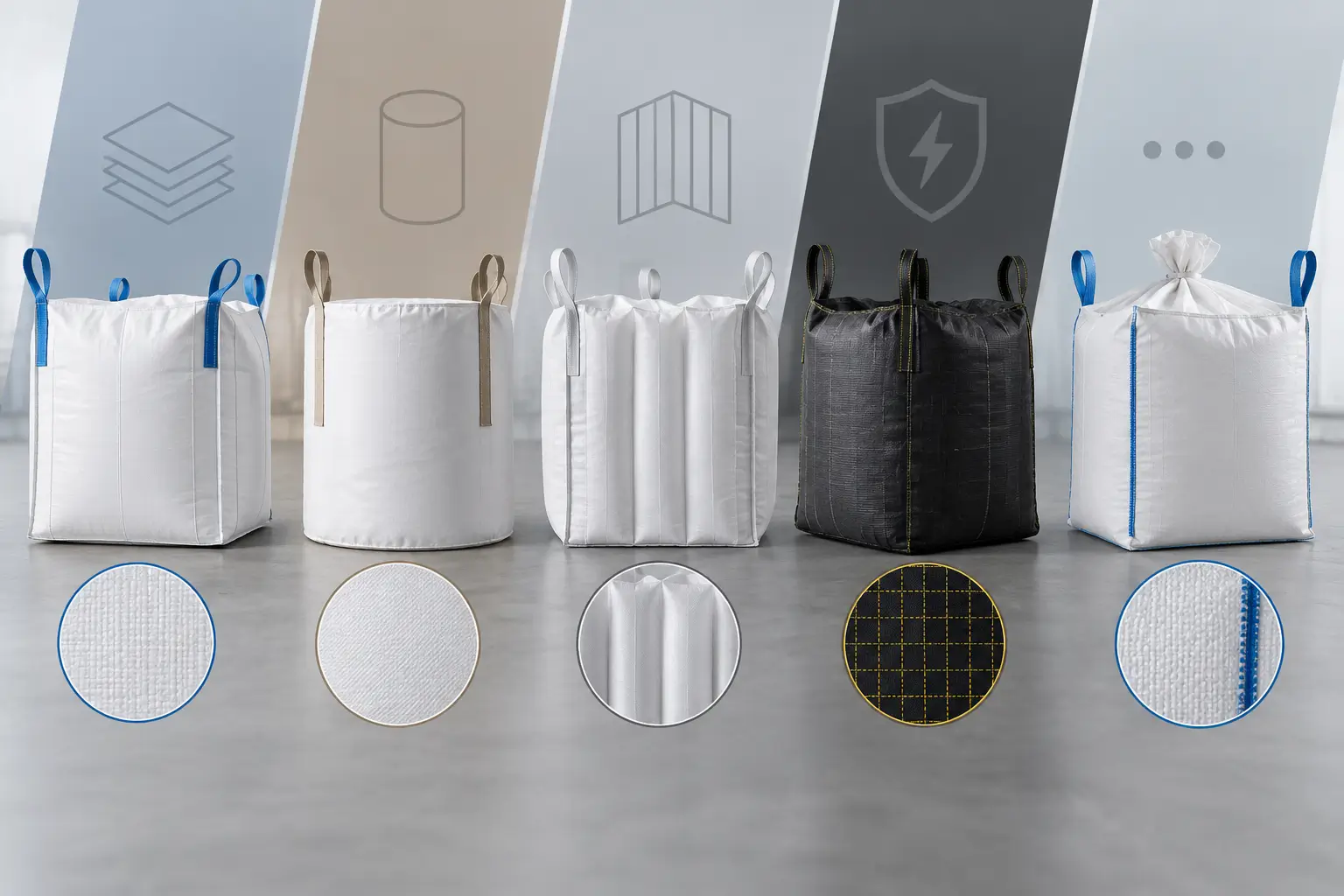
Quick answer: FIBC (Flexible Intermediate Bulk Container) bags come in several construction types, each suited to different products and handling needs. Panel bags are made from four separate fabric panels stitched together, offering a square, stable shape. Tubular bags are woven as a single continuous cylinder, making them stronger and more cost-efficient for standard bulk loads. Baffle (Q-bag) bags have internal fabric partitions that keep the bag’s shape square, maximizing storage and transport space. Conductive (Type C) bags include grounding threads to safely dissipate static electricity for hazardous or flammable powders. Beyond construction type, FIBCs also vary by loop configuration (single, two, or four loops) and ventilation (solid vs. ventilated fabric for airflow-sensitive products).
At Aeroflex Neu, we manufacture the full range of FIBC Bags – Panel, Tubular, Baffle Q-Bags, Conductive, Tunnel, Ventilated, and Single & Two Loop bags – to match the exact product, handling, and safety requirements of different industries. Here’s a breakdown of each type and when to use it.
Table of Contents
ToggleFIBC Bag Types at a Glance
| Type | Construction | Best For |
| Panel Bag | Four fabric panels stitched at the corners | General bulk goods, standard industrial use |
| Tubular Bag | Woven as one continuous cylindrical piece | Cost-efficient bulk storage/transport, higher strength |
| Baffle (Q-Bag) | Internal fabric baffles maintain square shape | Space-efficient stacking and shipping, palletized loads |
| Conductive (Type C) | Woven-in conductive threads, requires grounding | Flammable powders, chemicals, hazardous/explosive dust environments |
| Tunnel Bag | Loops pass through fabric tunnels sewn onto the body | Heavy loads needing reinforced, load-bearing lift points |
| Ventilated Bag | Mesh or perforated fabric panels | Products needing airflow (e.g., certain agricultural produce) |
| Single-Loop / Two-Loop | Varies by number and placement of lifting loops | Matched to forklift, crane hook, or specific handling equipment |
Panel FIBC Bags
Panel bags are constructed from four separate fabric panels sewn together at the vertical seams, giving the bag a naturally square cross-section. This construction makes them easy to fill, stack, and print on (each panel is a flat printable surface), which is why they’re a common choice for general industrial bulk packaging where branding also matters.
Tubular FIBC Bags
Tubular bags are woven on a circular loom as a single seamless cylinder, eliminating vertical seams. Because there are fewer stitched seams, tubular bags are generally considered stronger for the same fabric weight, and they’re typically more economical to manufacture – making them a popular choice for high-volume bulk shipments of minerals, chemicals, and agricultural products.
Baffle (Q-Bag) FIBC Bags
Baffle bags – sometimes called Q-bags – have internal fabric baffles stitched across the corners inside the bag. These baffles pull the bag into a squarer shape when filled, instead of bulging outward. The benefit is significant space efficiency: square-shaped bags stack more tightly on pallets and inside shipping containers, which can meaningfully reduce freight costs on large export orders.
Conductive (Type C) FIBC Bags
Conductive bags are woven with a grid of conductive threads throughout the fabric. When the bag is properly grounded during filling and emptying, these threads safely dissipate static electricity that could otherwise ignite flammable powders, solvents, or combustible dust. This bag type is essential – often mandatory – for chemical, pharmaceutical, and mineral powder applications where static discharge poses an explosion risk.
Tunnel FIBC Bags
Tunnel bags have their lifting loops threaded through fabric tunnels sewn onto the bag body, rather than stitched directly at the top corners. This construction spreads lifting stress more evenly across the bag, making tunnel bags a good choice for heavier loads or repeated crane/forklift handling.
Ventilated FIBC Bags
Ventilated bags use a mesh or perforated woven fabric that allows airflow through the bag while still containing the product. These are used for goods that need to breathe during storage or transport, such as certain vegetables, firewood, or produce where trapped moisture would cause spoilage.
Single-Loop vs. Two-Loop FIBC Bags
Beyond construction type, FIBCs also differ by the number of lifting loops:
- Single-loop bags have one loop that runs through the top of the bag, typically suited to forklift-mounted spike or single-hook lifting
- Two-loop bags have two loops for crane hook or dual-point lifting, offering more balanced weight distribution for heavier loads
The right configuration depends on the lifting equipment used at both the filling and receiving ends of the supply chain.
How to Choose the Right FIBC Type
- Identify the product’s hazard profile – if it’s a flammable powder or combustible dust, conductive (Type C) construction may be mandatory
- Check your handling equipment – forklift vs. crane determines loop configuration
- Consider storage and shipping space – Baffle/Q-bags save space if you’re optimizing container loads
- Factor in cost vs. strength – tubular bags often offer the best cost-to-strength ratio for standard bulk goods
- Check if airflow matters – ventilated bags are necessary for moisture-sensitive produce or organic material
FAQs
What is the difference between a panel and a tubular FIBC bag?
Panel bags are made from four stitched fabric panels, while tubular bags are woven as a single seamless cylinder – tubular bags are generally stronger and more cost-efficient, while panel bags offer more printable surface area.
When do I need a conductive (Type C) FIBC bag?
Conductive bags are needed whenever you’re packaging flammable powders, solvents, or combustible dust, where static discharge could pose a fire or explosion risk. They must be properly grounded during use to be effective.
What is a baffle or Q-bag FIBC?
A baffle (Q-bag) FIBC has internal fabric partitions that help the bag hold a square shape when filled, improving space efficiency during stacking and transport.
Should I choose a single-loop or two-loop FIBC bag?
It depends on your lifting equipment – single-loop bags suit forklift spike attachments, while two-loop bags are designed for crane hooks or dual-point lifting for heavier or more balanced loads.
What are ventilated FIBC bags used for?
Ventilated FIBC bags are used for products that need airflow during storage or transport, such as certain agricultural produce, to prevent moisture buildup and spoilage.
Find the Right FIBC Bag for Your Application
Aeroflex Neu manufactures Panel, Tubular, Baffle, Conductive, Tunnel, Ventilated, and Single/Two-Loop FIBC bags, engineered to match your product’s handling, safety, and space requirements. Explore our FIBC Bags range or contact us to discuss the right type for your next order.