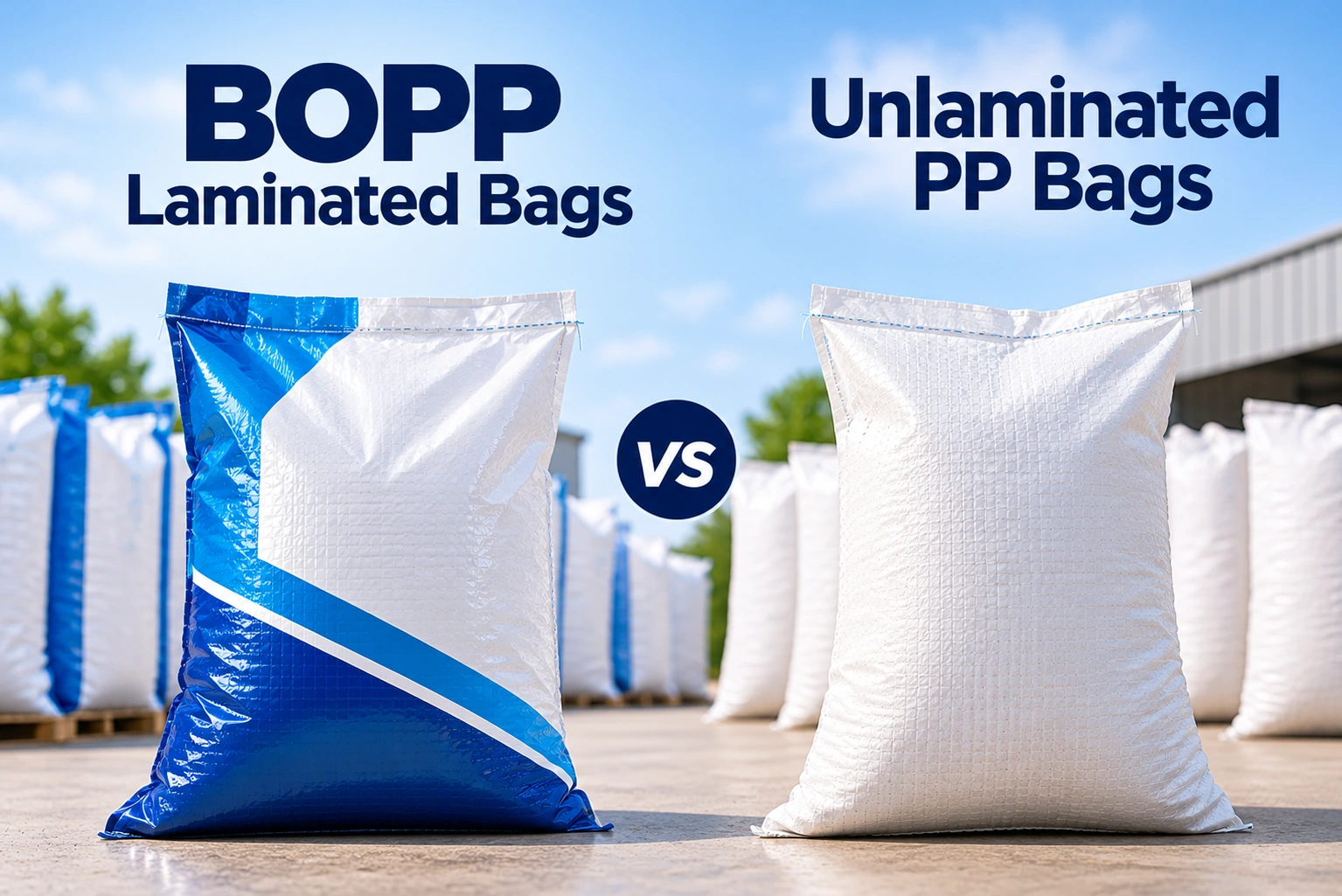
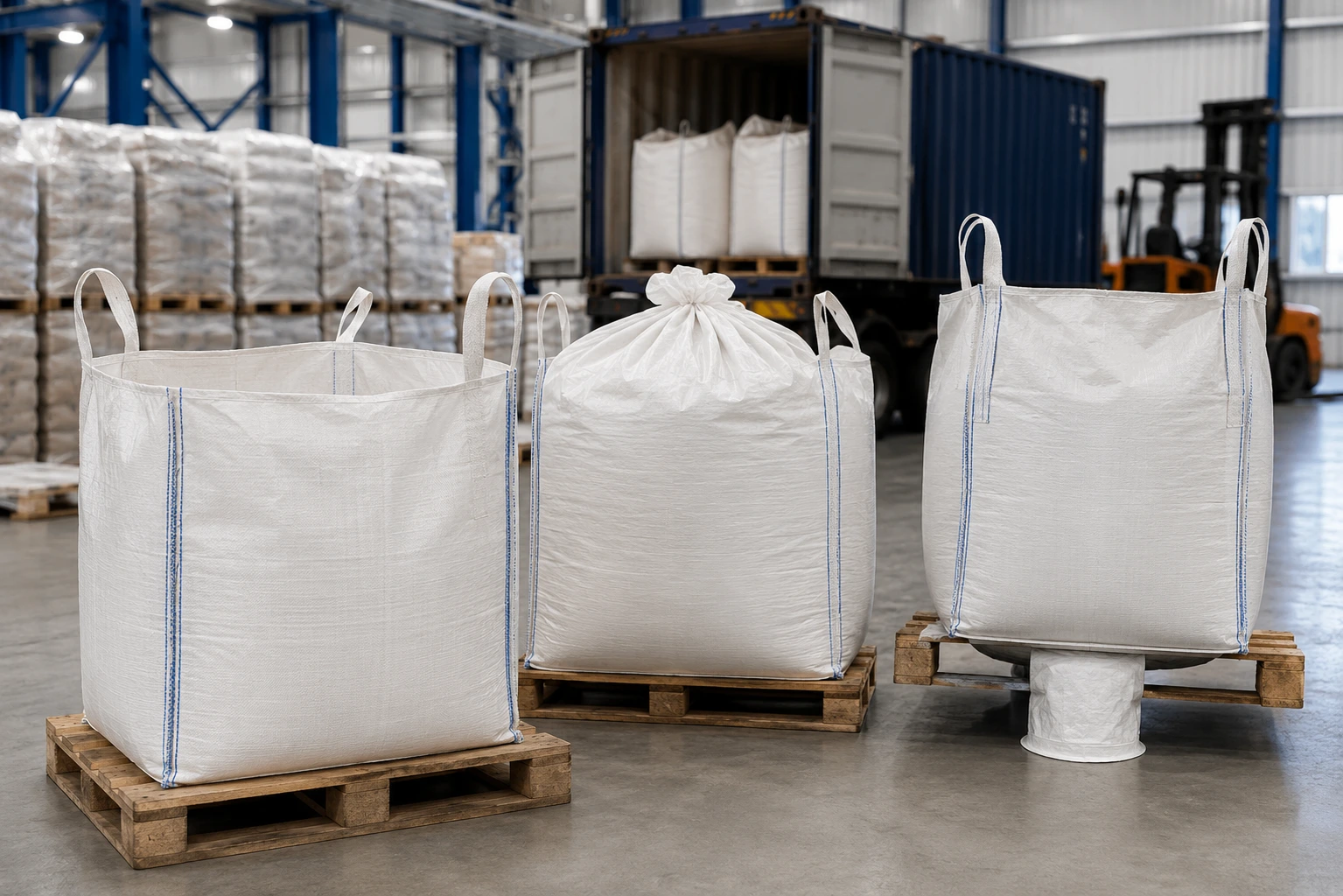
Picture a 20-foot shipping container being loaded at Mundra Port. Inside, instead of hundreds of individual 50 kg bags stacked on pallets, there are just 20 enormous woven bags – each one holding over a tonne of chemical powder, grain, or mineral aggregate. The loading takes a fraction of the time. The space inside the container is used more efficiently. And at the destination port, a single forklift and a crane hook gets the job done in minutes.
That’s the FIBC bag in action – and it’s one of the reasons Indian manufacturers and exporters across chemicals, agriculture, minerals, and construction are turning to this format in growing numbers in 2026.
FIBC Bag stands for Flexible Intermediate Bulk Container – though most people in the industry simply call them jumbo bags, bulk bags, or tone bags. They are large, load-bearing woven polypropylene bags designed to carry between 500 kg and 2,000 kg of bulk material in a single unit. If you’re a manufacturer or exporter dealing with bulk commodities and you haven’t yet evaluated whether FIBC jumbo bags belong in your logistics and packaging strategy, this guide is for you.
We’ll cover what FIBC bags are, how they work, the different types available, what they cost in India’s 2026 market, which industries rely on them, and what to look for in a reliable Indian FIBC manufacturer.
Table of Contents
ToggleWhat Exactly Is an FIBC Bag and How Does It Work?
FIBC Bag is the formal industry term for what most people call a jumbo bag or bulk bag. The name tells you exactly what it is: a flexible (as opposed to rigid) intermediate (between small retail packs and full tankers) bulk container made from woven polypropylene fabric.
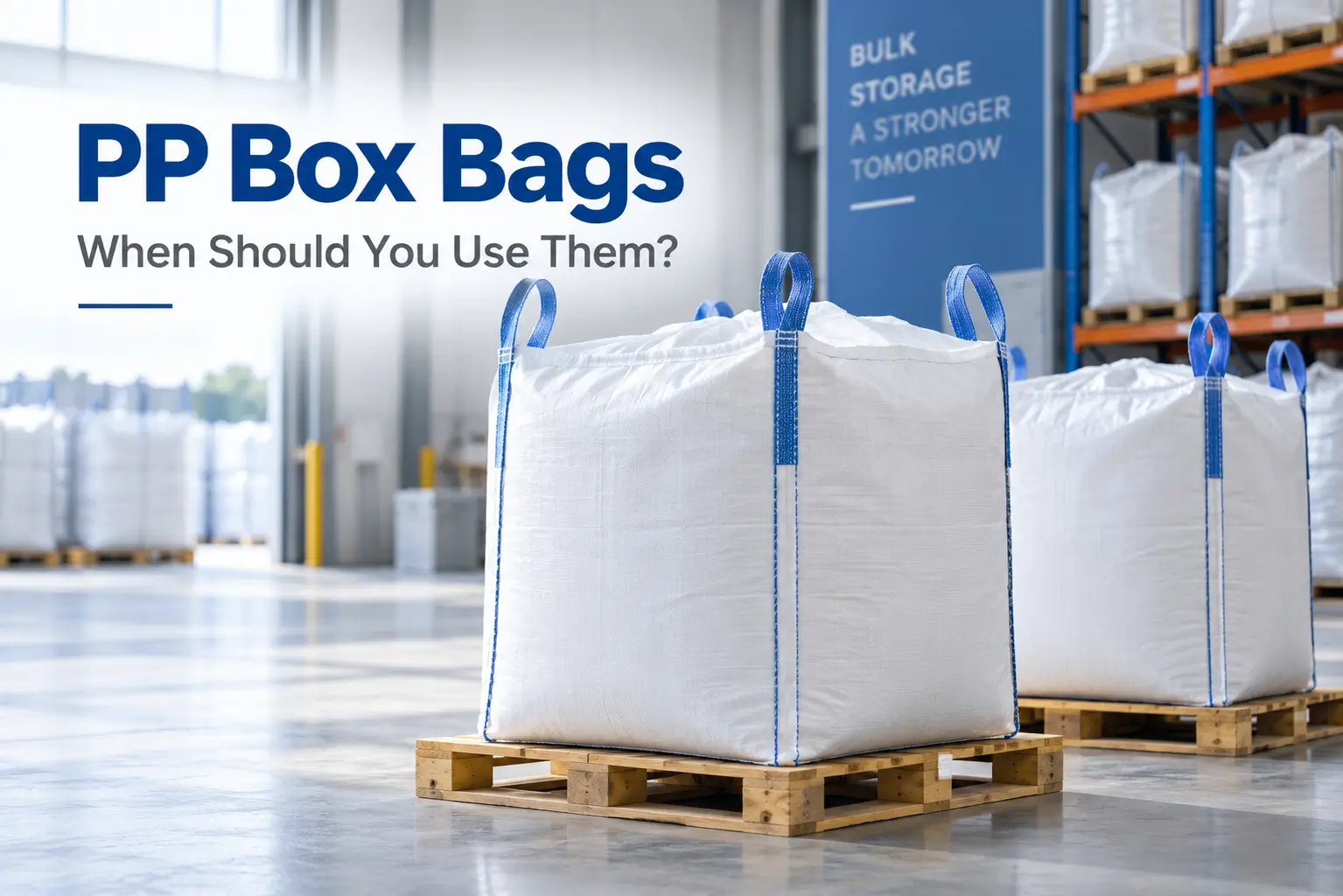
The basic structure of an FIBC bag consists of four main components:
- The body: Woven PP fabric panels stitched together to form the main container. The weave pattern and GSM (grams per square metre) of the fabric determines the bag’s load-bearing capacity.
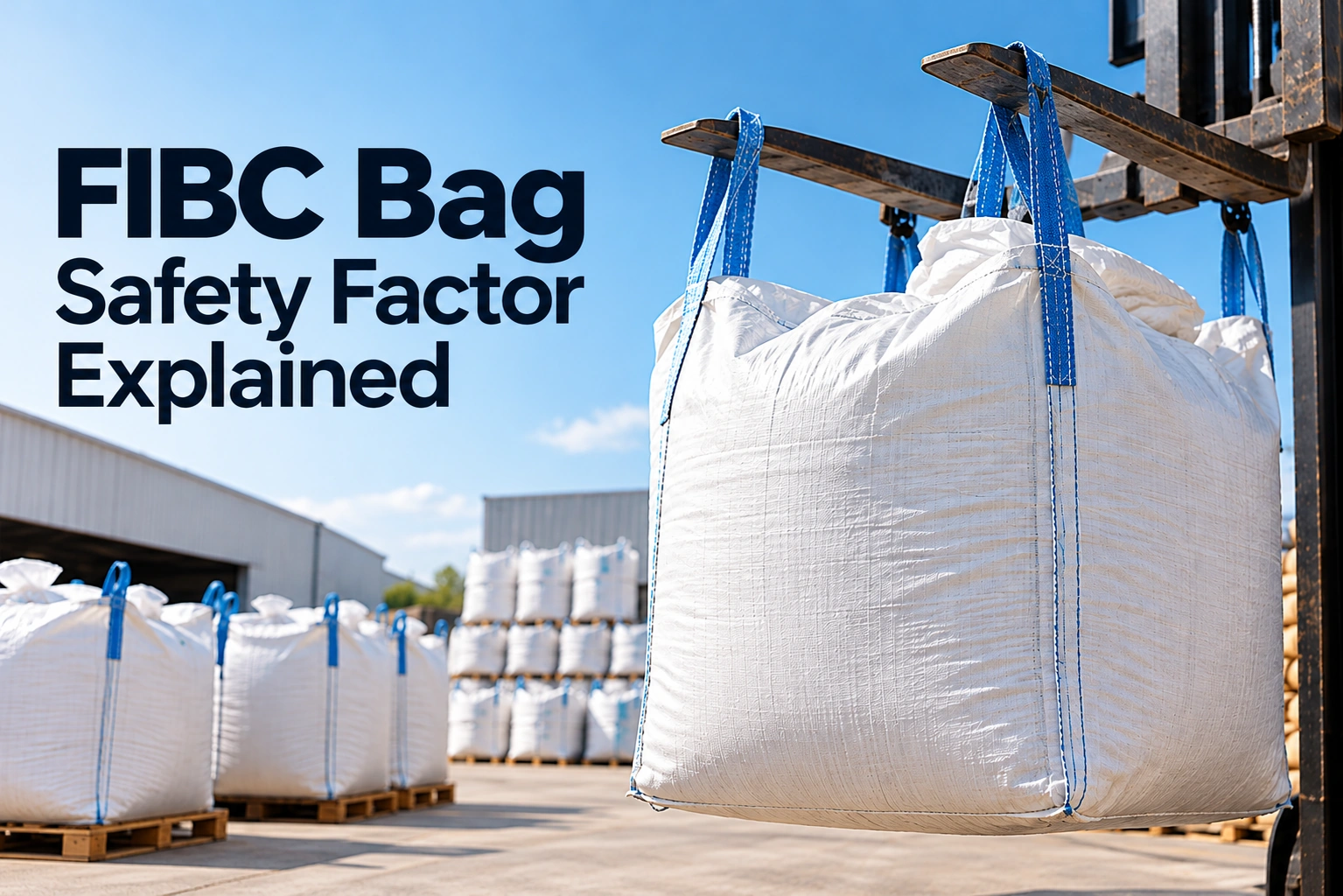
- The lifting loops: Typically, two or four polypropylene loops attached to the top corners or top panel of the bag. These are how the bag is lifted – by forklift tines or crane hooks – and they are engineered to carry the full safe working load (SWL) of the bag with a safety factor of at least 5:1 or 6:1.
- The top: Either an open top (for easy filling by conveyor or chute), a spout top (a narrower fill opening for controlled filling of fine powders), or a duffle top (a large fabric extension that can be tied off after filling).
- The bottom: Either a flat bottom (most common for free-flowing granules), a discharge spout (a controllable outlet at the base for gravity discharge of powders), or a full-open bottom (for rapid bulk discharge).
The bag is filled, typically by machine, and then lifted by crane or forklift for loading into shipping containers, trucks, or warehouse racking. At the destination, it’s discharged either through the bottom spout or by cutting the base – and in many cases, the bag itself is reconditioned and reused for subsequent shipments.
| What does FIBC stand for? FIBC stands for Flexible Intermediate Bulk Container. It refers to large woven polypropylene bags designed to carry bulk materials weighing between 500 kg and 2,000 kg per unit. They are also commonly called jumbo bags, bulk bags, tonne bags, or super sacks. FIBC bags are widely used in India and globally for transporting and storing chemicals, minerals, agricultural commodities, construction materials, and food-grade bulk products. |
What Are the Different Types of FIBC Bags Available in India?
FIBC Bags are not one-size-fits-all. The right type for your application depends on your product, your filling method, your discharge requirements, and any safety or regulatory considerations – particularly around electrostatic discharge for flammable materials.
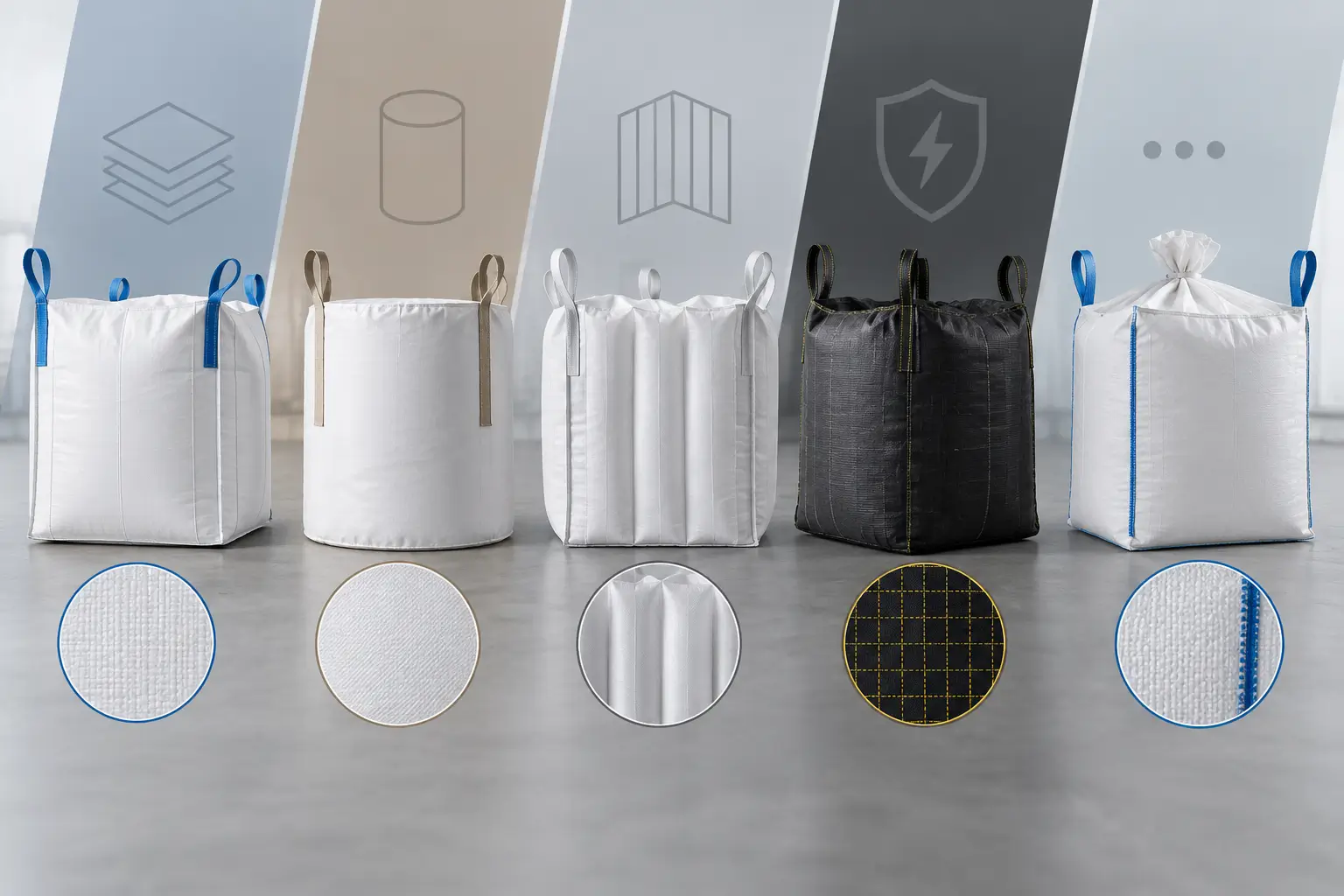
Here are the main types of FIBC bags used by Indian manufacturers and exporters in 2026:
Type A FIBC Bags
Type A bags are standard woven PP bags with no special anti-static properties. They are suitable for non-flammable products and environments where there is no risk of ignition from static electricity. Common uses include sand, gravel, non-hazardous minerals, and non-flammable agricultural commodities.
Type B FIBC Bags
Type B bags are made from materials with a low breakdown voltage, which prevents the occurrence of dangerous propagating brush discharges – a specific type of static spark that can ignite solvent vapours. They do not have antistatic properties themselves and cannot be used to transport flammable powders. They are suitable for dry, flammable powders in environments free from flammable vapours or gases.
Type C FIBC Bags (Conductive / Groundable Bags)
Type C bags are woven from conductive PP threads arranged in a grid pattern throughout the fabric. This creates a conductive network that can be grounded during filling and discharging, safely dissipating static electricity. They are required for flammable powders, solvents, and materials that generate static during handling. Grounding is mandatory – an ungrounded Type C bag provides no protection.
Type D FIBC Bags (Dissipative / Antistatic Bags)
Type D bags are made from special antistatic fabric that dissipates static charges safely without requiring a ground connection. They are suitable for flammable powders and solvents and offer the safety benefits of Type C without the need for grounding equipment at the filling or discharge point – making them the preferred choice in facilities where grounding infrastructure isn’t readily available.
Single-Loop vs Four-Loop FIBC Bags
Beyond the safety classification, FIBC bags are also distinguished by their lifting configuration. Single-loop bags (also called Q-bags or U-panel bags) use one continuous loop for lifting. Four-loop bags use individual loops at each corner, offering more stability during crane lifting and easier stacking. Four-loop bags are the most common format for heavy industrial applications in India and for international export shipments.
| What is the weight capacity of an FIBC jumbo bag? Standard FIBC jumbo bags are designed to carry between 500 kg and 2,000 kg per bag, with the most common capacities being 1,000 kg (1 tonne) and 1,500 kg. Each bag is engineered with a safety factor of 5:1 or 6:1, meaning a 1,000 kg safe working load bag is actually tested to hold 5,000 kg or 6,000 kg before failure. Always match the safe working load rating to your specific product weight and handling conditions. |
Why Are Indian Manufacturers and Exporters Switching to FIBC Bags in 2026?
FIBC Bags solve problems that smaller packaging formats simply can’t address efficiently at scale. For Indian manufacturers handling bulk volumes – whether for domestic distribution or export – the economics and logistics case is increasingly compelling.
Dramatically Lower Packaging and Labour Costs
Consider a chemical manufacturer shipping 20 tonnes of material per container. Using 50 kg standard woven bags, that’s 400 individual bags – each one filled, stitched, stacked, loaded, unloaded, and handled at the destination. Using 1,000 kg FIBC jumbo bags, the same shipment requires just 20 bags. The reduction in filling time, labour, palletisation, and handling at both ends of the shipment is substantial.
According to Aeroflex Neu’s 2026 India market insights, manufacturers switching from standard 50 kg bags to FIBC format for bulk shipments typically report a 30–45% reduction in overall packaging and logistics handling costs per tonne shipped – a figure that adds up quickly at export volumes.
Better Space Utilisation in Containers and Warehouses
FIBC bags fill container space more efficiently than rigid drums or palletised small bags. A standard 20-foot shipping container can accommodate 18 to 22 one-tonne FIBC bags, depending on bag dimensions and product density – often achieving better payload utilisation than equivalent small-bag shipments. In warehousing, FIBC bags can be stacked two to three high when properly designed, significantly reducing the floor space required for bulk inventory storage.
Growing Export Demand for FIBC Packaging
India’s chemical exports exceeded ₹2.6 lakh crore in FY2025-26, with minerals, agricultural commodities, and construction materials contributing significantly to bulk export volumes. International buyers – particularly in Europe, the USA, and Australia – frequently specify FIBC packaging as a requirement for bulk orders, both for logistics efficiency and because FIBC bags align with their own receiving and warehouse management systems.
Reusability and Sustainability
A well-manufactured FIBC bag is built to be used multiple times – typically 3 to 5 cycles for standard bags, and up to 10 to 15 cycles for specialist reconditioned bags used in closed industrial loops. This reusability significantly reduces packaging waste per tonne shipped compared to single-use alternatives. In 2026, this reusability factor is increasingly cited by Indian exporters as a selling point with European buyers who face strict import packaging sustainability requirements.
| Can FIBC bags be reused? Yes. Standard FIBC bags are designed for multiple uses, typically 3 to 5 cycles for general-purpose bags. Bags used in food-grade or pharmaceutical applications are usually single-use for hygiene and contamination reasons. Reconditioned FIBC bags – professionally inspected, cleaned, and certified – can achieve 10 or more cycles in appropriate closed industrial applications. Always inspect bags before reuse for fabric damage, seam integrity, and loop condition. |
Which Industries in India Use FIBC Jumbo Bags?
FIBC Bags are one of the most widely used bulk packaging formats across Indian industry. The combination of high load capacity, flexible design options, and cost efficiency makes them suitable for an enormous range of applications.
Chemicals and Petrochemicals
India’s chemical industry is one of the largest users of FIBC bags globally. Pigments, dyes, polymer granules, fertilisers, industrial salts, and chemical powders of all kinds move in FIBC format both domestically and in export shipments. Depending on the flammability and static sensitivity of the product, Type C or Type D antistatic bags may be required.
Agriculture and Food Commodities
Rice, wheat, sugar, soya meal, and a range of agricultural commodities are increasingly being shipped in FIBC format for bulk international trade. Food-grade FIBC bags – manufactured from virgin PP resin with food-safe liners – are required for direct food contact applications and are certified to relevant food safety standards. India’s agricultural export volumes make this one of the fastest-growing FIBC segments in 2026.
Mining and Minerals
Silica sand, calcium carbonate, talc, barite, and various industrial minerals are heavy, high-volume commodities that ship almost exclusively in FIBC format. The ability of FIBC bags to handle 1,000 to 2,000 kg per unit makes them the only practical packaging option for bulk mineral exports at competitive freight rates.
Construction Materials
Cement, fly ash, gypsum, and construction chemical powders are packaged in FIBC bags for large project supplies and bulk contractor deliveries. In India’s infrastructure boom – with construction output projected to exceed ₹25 lakh crore in FY2025-26 – the demand for bulk construction material packaging is growing in parallel.
Pharmaceuticals and Nutraceuticals
While individual pharmaceutical products are packaged in much smaller units, bulk active pharmaceutical ingredients (APIs) and nutraceutical powders move between manufacturing facilities in food-grade or pharmaceutical-grade FIBC bags. India is one of the world’s largest API exporters, and FIBC packaging for API bulk shipments is a highly specialised, high-compliance segment of the market.
| Are FIBC bags safe for food products? Yes, when manufactured to food-grade specifications. Food-grade FIBC bags are made from virgin polypropylene resin without recycled content or contaminants, and typically include a food-safe inner liner (usually PE film) to provide an additional barrier against moisture and contamination. Food-grade FIBC bags comply with FSSAI requirements in India and relevant international food contact material regulations for export. Always specify food-grade certification when ordering bags for direct food contact applications. |
What Does an FIBC Bag Cost in India in 2026?
FIBC Bag pricing in India in 2026 varies based on several key factors: bag capacity, fabric GSM, number of lifting loops, top and bottom configuration, liner requirements, and any special treatments such as antistatic properties or UV stabilisation.
Here is a realistic overview of FIBC bag pricing in the Indian market for 2026:
- Standard 4-loop FIBC bag (1,000 kg SWL, flat bottom, open top, no liner): ₹280 to ₹380 per bag for bulk orders of 500 units and above.
- Standard FIBC bag with PE inner liner (1,000 kg SWL, food-grade compatible): ₹340 to ₹460 per bag depending on liner thickness and specification.
- Discharge spout bottom FIBC bag (1,000–1,500 kg SWL, fill spout top): ₹380 to ₹520 per bag for standard non-antistatic applications.
- Type C antistatic FIBC bag (conductive fabric, 1,000 kg SWL, groundable): ₹480 to ₹680 per bag, reflecting the higher cost of conductive PP weaving materials.
- Type D antistatic FIBC bag (dissipative fabric, 1,000 kg SWL): ₹520 to ₹750 per bag for standard capacity configurations.
- Heavy-duty FIBC bag (2,000 kg SWL, 4-loop, double-stitched seams): ₹580 to ₹820 per bag for high-load industrial applications.
- Baffle FIBC bag (internal baffles for square shape retention during transport): ₹420 to ₹580 per bag, premium over standard round-body bags.
For export orders, freight and insurance costs add approximately ₹15 to ₹35 per bag to the landed cost, depending on destination, container type, and Incoterms. Most Indian FIBC manufacturers quote on FOB (Free on Board) or CIF (Cost, Insurance, and Freight) basis for international buyers.
Minimum order quantities for custom FIBC bags from Indian manufacturers typically range from 200 to 500 units, though some standard configurations are available in smaller trial quantities for new buyers testing a format before committing to full production runs.
| What is the price of an FIBC jumbo bag in India in 2026? FIBC jumbo bag prices in India in 2026 typically range from ₹280 to ₹820 per bag depending on capacity (500 kg to 2,000 kg), fabric GSM, antistatic type, liner requirements, and order volume. Standard 1,000 kg bags without liners start at around ₹280 to ₹380 per unit for bulk orders. Antistatic (Type C or D) and food-grade bags with liners carry a premium of ₹150 to ₹400 per bag over standard configurations. |
How Does Aeroflex Neu Manufacture High-Quality FIBC Jumbo Bags?
At Aeroflex Neu, we manufacture FIBC jumbo bags at our production facility in Udaipur, Rajasthan, with full in-house capability across fabric weaving, cutting, stitching, loop attachment, and liner insertion. Every bag we produce is engineered to perform – not just to meet minimum specifications, but to reliably protect your product and your supply chain.
Engineering for Load Integrity
Every FIBC bag design starts with the load. We work with clients to confirm the safe working load required, the product’s bulk density, and the handling conditions at both the filling and discharge points. From that, we specify the fabric GSM, weave pattern, seam configuration, and loop attachment method – because an FIBC bag that’s engineered correctly for your application performs reliably, while one that’s spec’d generically may fail under real-world conditions.
Loop Testing That Goes Beyond Compliance
Aeroflex Neu’s high-strength FIBC jumbo bags are tested to a minimum safety factor of 6:1 on loop strength – meaning a bag rated at 1,000 kg safe working load is tested to 6,000 kg before failure. This is above the minimum 5:1 safety factor specified by ISO 21898 (the primary international standard for FIBC bags) and reflects our commitment to building bags that perform conservatively under the unpredictable conditions of real-world logistics.
Food-Grade Production Standards
For food-grade FIBC bags, we maintain strict production protocols: virgin PP resin only, dedicated production lines free from industrial contamination, food-safe PE liner insertion in clean conditions, and full batch documentation for traceability. We supply food-grade FIBC bags to Indian exporters shipping agricultural commodities to markets in Europe, the Middle East, and Asia-Pacific, where food contact material compliance is audited by buyers.
Export Documentation and Compliance
We provide complete export documentation for international FIBC orders: test certificates, GSM reports, loop strength test results, material safety data sheets, and country-of-origin certificates. For markets with specific packaging import regulations – including EU PPWR compliance documentation and US FDA conformity letters for food-grade bags – we work with clients to ensure all documentation is in order before shipment.
| What certifications should an FIBC bag manufacturer have? Reputable FIBC bag manufacturers should hold ISO 9001 certification for quality management systems, and their bags should be tested in accordance with ISO 21898 – the international standard covering FIBC design, testing, and marking. For food-grade applications, look for manufacturers with food contact material compliance documentation and FSSAI compliance for the Indian market. For antistatic bags, ask for test certificates confirming the bag’s classification as Type B, C, or D per IEC 61340-4-4. |
Making the Right Call on Bulk Packaging: Is an FIBC Bag Right for Your Business?
If you’re a manufacturer or exporter moving bulk commodities – chemicals, minerals, agricultural products, or construction materials – and you’re still relying entirely on smaller bag formats, it’s worth doing the numbers on FIBC bags. The labour savings, logistics efficiency, container utilisation, and the growing expectation from international buyers make a compelling case.
FIBC Bags aren’t for every application. For retail-format products, for commodities that require individual consumer packs, or for shipments where FIBC lifting and discharge equipment isn’t available at the destination, smaller bag formats remain the right choice. But for bulk industrial and export applications, the FIBC format is often the most cost-effective packaging decision a manufacturer can make.
The key is working with a manufacturer who understands not just how to make FIBC bags, but how to engineer them for your specific product, your handling conditions, and your export market requirements. That’s exactly what Aeroflex Neu Limited specialises in.
If you’d like to explore FIBC jumbo bag options for your business – including specifications, safety classifications, food-grade options, and bulk pricing – visit our FIBC jumbo bag manufacturer page and get in touch. We’ll help you find the right bag for the right application, at the right price.
Frequently Asked Questions
Q1. What is the difference between an FIBC bag and a regular PP woven bag?
A regular PP woven bag typically holds 5 kg to 50 kg of material and is designed for individual handling by a person. An FIBC bag holds 500 kg to 2,000 kg and is designed to be lifted by forklift or crane using built-in lifting loops. FIBC bags are made from heavier-weight PP woven fabric with reinforced seams and engineered loops, and they are used for bulk industrial logistics rather than retail or distributor-level packaging.
Q2. How do I choose the right type of FIBC bag for my product?
Start with your product’s weight and bulk density to determine the safe working load required. Then consider whether your product or handling environment involves flammable materials or static electricity risks – if so, you’ll need Type C or Type D antistatic bags. Consider whether your product is food-grade (requiring virgin PP resin and a food-safe liner) and what filling and discharge method you’ll use (open top, spout top, flat bottom, or discharge spout). A good FIBC manufacturer will walk you through this specification process.
Q3. What is the safe working load (SWL) of an FIBC jumbo bag?
Safe working load (SWL) is the maximum weight an FIBC bag is designed to carry in normal use. Standard FIBC bags are available in SWL ratings of 500 kg, 750 kg, 1,000 kg, 1,500 kg, and 2,000 kg. By international standard (ISO 21898), each bag must be tested to a minimum of 5 times its SWL – so a 1,000 kg bag must pass a 5,000 kg test. Always use bags rated at or above your actual product weight, with a margin for safe handling.
Q4. Can FIBC bags be used for exporting from India?
Yes, FIBC bags are one of the most widely used export packaging formats for Indian bulk commodity exporters. They are classified under HS Code 6305 and are accepted at all major Indian ports. Export-grade FIBC bags should carry test certificates confirming safe working load, and buyers in regulated markets (EU, USA, Australia) may require additional documentation including material conformity, food-grade certification, or antistatic classification certificates.
Q5. What is a baffle FIBC bag and when should I use one?
A baffle FIBC bag has internal fabric panels (baffles) sewn into the corners of the bag to help it retain a square or rectangular shape when filled, rather than bulging outward into a rounded form. Baffled bags stack more efficiently in containers and warehouses, making better use of available space. They are particularly useful for fine or free-flowing powders that tend to cause non-baffled bags to lose shape during filling and transport.
Q6. How do I place an order for FIBC jumbo bags from Aeroflex Neu?
Visit aeroflexneu.com/fibc-jumbo-bag-manufacturer and share your requirements: product type, required capacity (SWL), filling and discharge configuration, liner requirements, antistatic classification if needed, order quantity, and delivery timeline. Our team will provide a detailed technical specification and quotation within 48 business hours. We supply FIBC bags for both domestic Indian distribution and international export, with full documentation support.