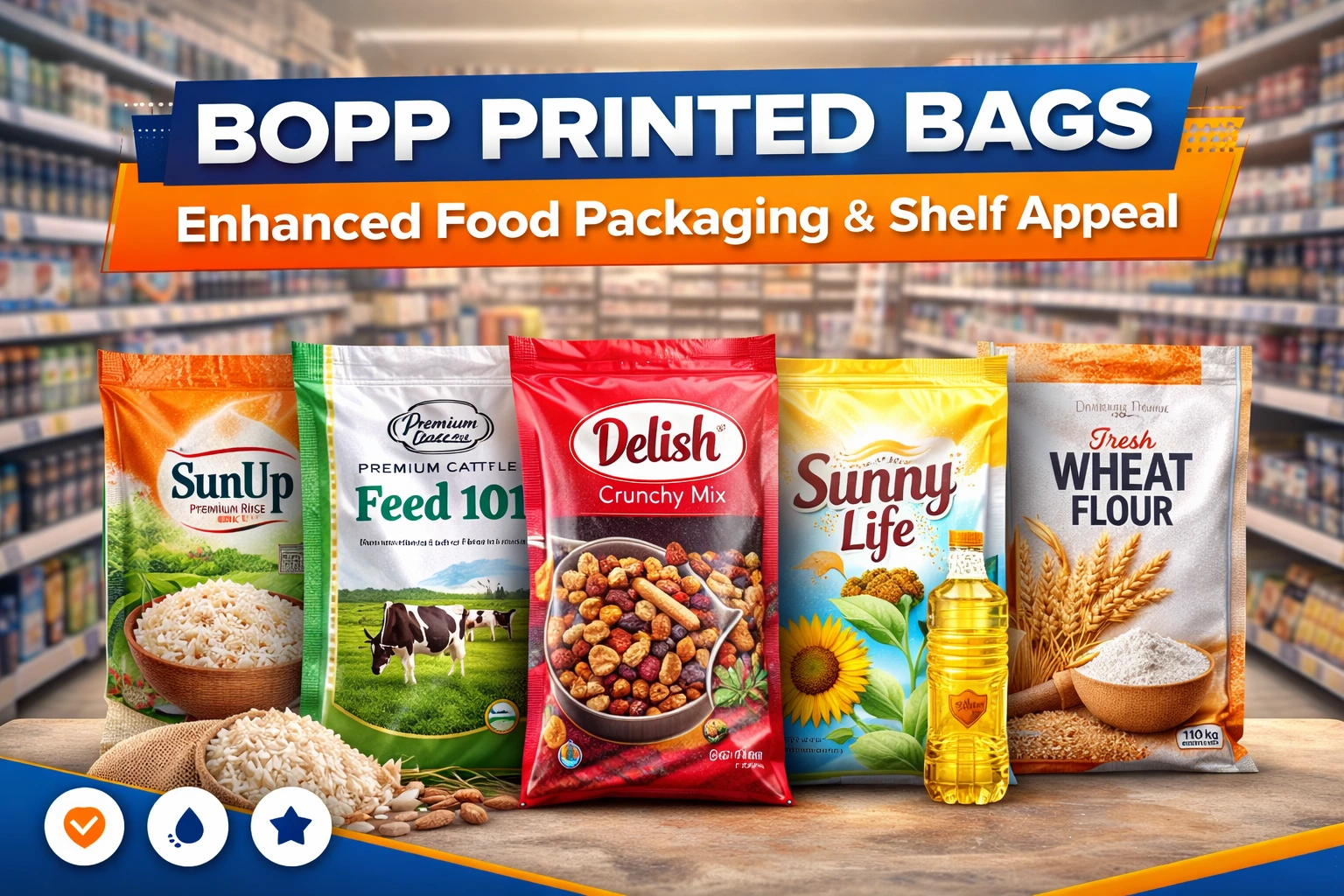
BOPP Printed Bags have emerged as one of the most sought-after packaging formats in India’s food and retail sectors. With India’s packaged food market crossing ₹8.5 lakh crore in 2026 and export shipments to the Gulf, Africa, and Southeast Asia reaching record volumes, the need for packaging that combines visual impact with structural integrity has never been more pressing.
Today’s buyers – whether they are supermarket shoppers in Mumbai, wholesale distributors in Dubai, or procurement officers in London – make instant judgements based on how a product looks on the shelf or pallet. BOPP laminated woven bags combine the tensile strength of woven polypropylene with the high-gloss, photographic-quality printing surface of Biaxially Oriented Polypropylene film, creating packaging that both protects and sells the product inside.
In this article, we break down how BOPP printed bags are transforming food packaging and shelf appeal – and why partnering with a proven manufacturer like Aeroflex Neu gives businesses the quality assurance, customisation depth, and export compliance they need to compete in 2026 and beyond.
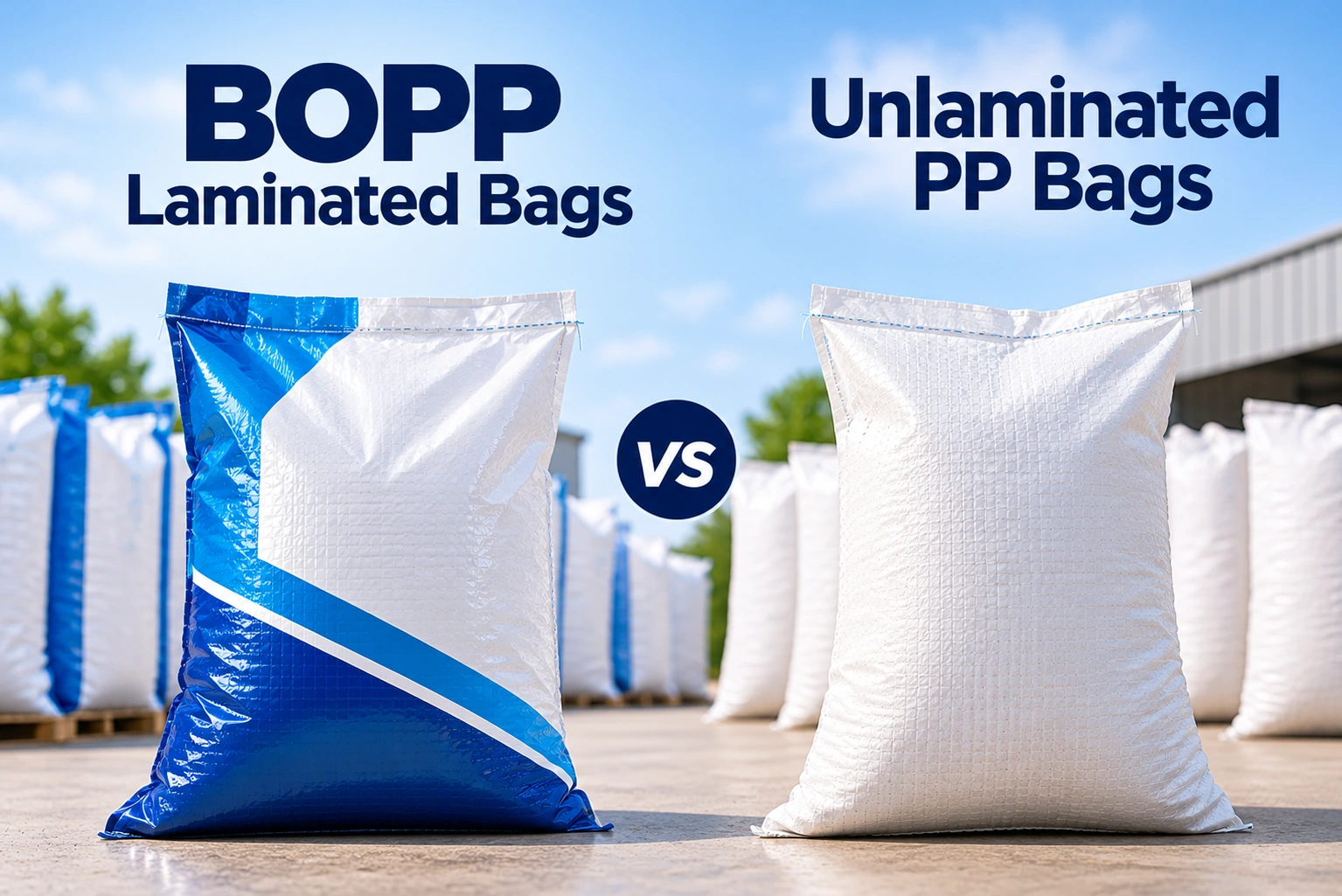
| 01 What Are BOPP Printed Bags and Why Are They Different? BOPP Printed Bags are woven polypropylene bags laminated with a Biaxially Oriented Polypropylene (BOPP) film on the outer surface. This lamination layer serves two distinct functions: it provides a high-clarity, moisture-resistant outer surface that enhances print quality dramatically, and it adds an additional protective barrier that standard unlaminated PP woven bags do not offer. The key differentiators of BOPP laminated woven bags versus standard PP woven bags include: Print quality: Up to 8-colour photographic printing vs. basic 2–3-colour flexo on unlaminated bagsSurface finish: Glossy or matte laminate options that resist scuffing, moisture, and UV fadingBrand differentiation: Full-wrap printed panels that transform a utility bag into a retail-grade display unitBarrier properties: Reduced moisture vapour transmission, protecting dry food products from humidityStructural strength: The PP woven base retains full load-bearing capacity up to 50 kg while the laminate protects the print layer At Aeroflex Neu, we manufacture BOPP laminated woven bags with print registration accuracy within ±0.5 mm, ensuring crisp, consistent branding across every unit in a bulk order – whether that order is 10,000 bags or 10 lakh bags. |
| 02 Why Are BOPP Printed Bags the Preferred Choice for Indian Food Brands? BOPP Printed Bags have become the default choice for premium food brands in India because the modern retail environment demands packaging that works harder. With over 14,000 modern retail outlets operating across India in 2026, shelf competition is fierce. A bag’s visual presentation directly influences purchase decisions, particularly for commodities like basmati rice, atta (wheat flour), dal, sugar, and spices – categories where brand differentiation is achieved almost entirely through packaging. Food categories that most commonly use BOPP laminated woven bags in India: Basmati and non-basmati rice (5 kg, 10 kg, 25 kg, 50 kg packs)Wheat flour (atta) for branded retail and institutional supplyPulses, lentils, and legumes for both domestic retail and exportSugar and salt for bulk retail and food service channelsAnimal feed, aquaculture feed, and poultry mealDry spices and condiment blends for branded retail According to Aeroflex Neu’ 2026 India market insights, over 80% of organised food brands packaging commodities in 5 kg to 50 kg formats have transitioned from plain woven PP to BOPP laminated formats in the past three years. The investment in premium packaging consistently delivers measurable improvements in retail sell through rates and consumer brand recall. |
| 03 How Do BOPP Printed Bags Improve Shelf Appeal and Brand Visibility? BOPP Printed Bags turn every square centimetre of packaging into a branding canvas. Unlike jute bags, paper packaging, or plain-woven sacks, BOPP laminated bags support full photographic imagery, gradient colour fields, embossed-effect lamination, and metallised finishes – all of which make a product stand out on a crowded supermarket shelf or a stacked warehouse pallet. Brand-building features of BOPP laminated bags: High-definition printing: Rotogravure and flexographic printing with DPI levels that reproduce brand colours with Pantone accuracyFinish options: Gloss laminate for vibrant retail appeal or matte laminate for a premium, understated lookFull-wrap coverage: 360-degree printed panels with no blank reverse – every face of the bag carries brand messagingQR code integration: Machine-readable codes for traceability, consumer engagement, and anti-counterfeiting programmesRegulatory print panels: Space for FSSAI licence number, nutritional information, MRP, batch number, and expiry date in compliant font sizes A 2025 Nielsen India shelf-impact study found that consumers spend an average of 2.7 seconds evaluating a packaged food product on the shelf before making a decision. BOPP laminated packaging’s visual clarity and colour vibrancy have been shown to improve product selection rates by up to 34% compared to plain woven bags in the same category. |
| 04 How Does BOPP Lamination Extend the Shelf Life of Food Products? BOPP Printed Bags are not merely a visual upgrade – they deliver measurable improvements in product protection. The BOPP film layer creates a moisture vapour barrier that significantly reduces the rate at which humidity penetrates the packaging, a critical factor for dry food products stored in India’s variable climate zones. India’s coastal regions, including Maharashtra, West Bengal, Kerala, Odisha, and Tamil Nadu, experience relative humidity levels exceeding 80% during the monsoon season. In these conditions, unlaminated PP woven bags allow moisture ingress that accelerates clumping, mould growth, and spoilage of grain and flour products. BOPP laminated bags reduce this risk substantially, extending effective shelf life by 2 to 4 months for sensitive dry food commodities in high-humidity environments. Protective features that extend food quality: BOPP film reduces moisture vapour transmission rate (MVTR) by up to 60% vs. unlaminated PP wovenInner PE liner option adds a secondary food-contact-safe barrier layerHeat-sealed closures prevent insect ingress and maintain airtight integrityUV-resistant laminate protects light-sensitive products like spices and whole grains from photodegradation Aeroflex Neu’ BOPP laminated woven bags are available with a range of PE liner weights – from 30 micron to 80 micron – allowing food manufacturers to calibrate the protection level precisely to their product’s sensitivity and supply chain transit time. |
| 05 Why Are BOPP Printed Bags Essential for Indian Food Exporters in 2026? BOPP Printed Bags are rapidly becoming a non-negotiable requirement for Indian food exporters targeting premium international markets. Importing nations – particularly in the European Union, the United Kingdom, the United States, and the Gulf Cooperation Council – apply strict standards to food packaging, covering material safety, print quality, labelling accuracy, and moisture protection. Key export compliance requirements that BOPP laminated bags help meet: EU Regulation (EC) 1935/2004: Materials in contact with food must not transfer components that endanger human healthGCC Standardisation Organisation (GSO): Labelling and packaging standards for food imports into UAE, Saudi Arabia, and KuwaitUS FDA 21 CFR: Food-contact material guidelines for exports to North American marketsFSSAI Export Standards: India’s own packaging regulations applicable to food products leaving the country under APEDA-registered facilities India’s DGFT data from Q1 2026 shows that packaging non-compliance was cited in 18% of food export rejections at destination ports – making certified, export-ready packaging one of the most commercially important investments an exporter can make. At Aeroflex Neu, we manufacture BOPP laminated woven bags with full documentation support for export clients, including material safety data sheets (MSDS), food-grade compliance certificates, and third-party inspection readiness for SGS and Bureau Veritas pre-shipment audits. |
| 06 How Do BOPP Printed Bags Support Sustainable Packaging Goals? BOPP Printed Bags are increasingly aligned with India’s sustainability agenda. Under the Plastic Waste Management Rules 2022 (amended 2024) and the Extended Producer Responsibility (EPR) framework, food packaging manufacturers and brand owners are required to register, track, and ensure the recyclability of their packaging portfolio. Sustainability credentials of BOPP laminated woven bags: Both the PP woven substrate and BOPP film are polypropylene-family polymers, making the bag a monomaterial structure that is easier to recycle than multi-layer composite filmsBOPP laminated bags support 2 to 3 reuse cycles for non-food industrial storage before disposalPost-consumer recycled (PCR) PP content options available for brands with ESG commitmentsLonger product shelf life reduces food waste along the supply chain, improving the overall sustainability of the packaged goods category India’s CIPET (Central Institute of Petrochemicals Engineering & Technology) reported in 2025 that polypropylene-family packaging has a recycling rate of over 74% through organised collection streams in tier-1 and tier-2 Indian cities – one of the highest recycling rates among flexible packaging formats available to the Indian food industry. |
Table of Contents
ToggleConclusion: Packaging That Protects, Sells, and Travels
BOPP Printed Bags represent the convergence of three fundamental packaging priorities: structural protection, visual brand impact, and regulatory compliance. In 2026’s competitive Indian food market and its demanding export corridors, no other single-format packaging solution delivers all three as effectively as BOPP laminated woven bags.
From extending the shelf life of moisture-sensitive grains to creating shelf standout in modern retail, from satisfying EU food contact regulations to supporting India’s EPR sustainability mandates, BOPP laminated woven bags have earned their place as the definitive premium packaging format for the Indian food industry.
Whether you are a rice miller in Haryana scaling exports to the Middle East, an atta brand expanding into modern retail across Maharashtra, or a dal manufacturer building an international buyer network, the right BOPP laminated bag is a strategic asset. Explore Aeroflex Neu’ full BOPP laminated woven bag range → and speak to our packaging specialists about specifications, certifications, and bulk order timelines.
Frequently Asked Questions
Q What are BOPP printed bags used for in the food industry?
BOPP printed bags are used to package a wide range of dry food products including rice, wheat flour (atta), pulses, sugar, salt, animal feed, and dry spices. They offer superior print quality for branding, moisture resistance to protect food quality, and food-grade compliance for both domestic retail and international export.
Q How do BOPP laminated bags protect food from moisture?
The BOPP film laminated to the outer surface of the woven bag creates a moisture vapour barrier that reduces the rate of humidity penetration by up to 60% compared to unlaminated PP woven bags. For added protection, inner PE liners can be added to create a secondary food-contact-safe barrier layer.
Q Are BOPP printed bags compliant with Indian food packaging regulations?
Yes. BOPP laminated woven bags manufactured with food-grade PP resin and food-safe inks comply with FSSAI packaging guidelines. For export markets, they can be produced to meet EU Regulation (EC) 1935/2004, GCC GSO standards, and US FDA 21 CFR food-contact material requirements.
Q What is the minimum order quantity for custom BOPP printed bags?
Minimum order quantities for custom BOPP printed bags typically start from 10,000 to 25,000 units depending on the size, number of print colours, and finish specification. Manufacturers with large-scale rotogravure printing infrastructure can often accommodate phased delivery schedules to help buyers manage inventory.
Q How long does it take to produce custom BOPP laminated woven bags?
Standard lead times for custom BOPP laminated woven bags – including artwork approval, plate preparation, and production – typically range from 15 to 25 working days for first-time orders. Repeat orders with existing artwork and approved samples generally have shorter turnaround times of 10 to 18 working days depending on quantity.
Q Can BOPP printed bags carry product information required by FSSAI?
Yes. BOPP laminated bags provide a high-clarity print surface that easily accommodates all mandatory FSSAI labelling requirements including product name, ingredient list, nutritional information, FSSAI licence number, net weight, MRP, manufacturing date, best-before date, and storage instructions – all in compliant font sizes and contrast ratios.