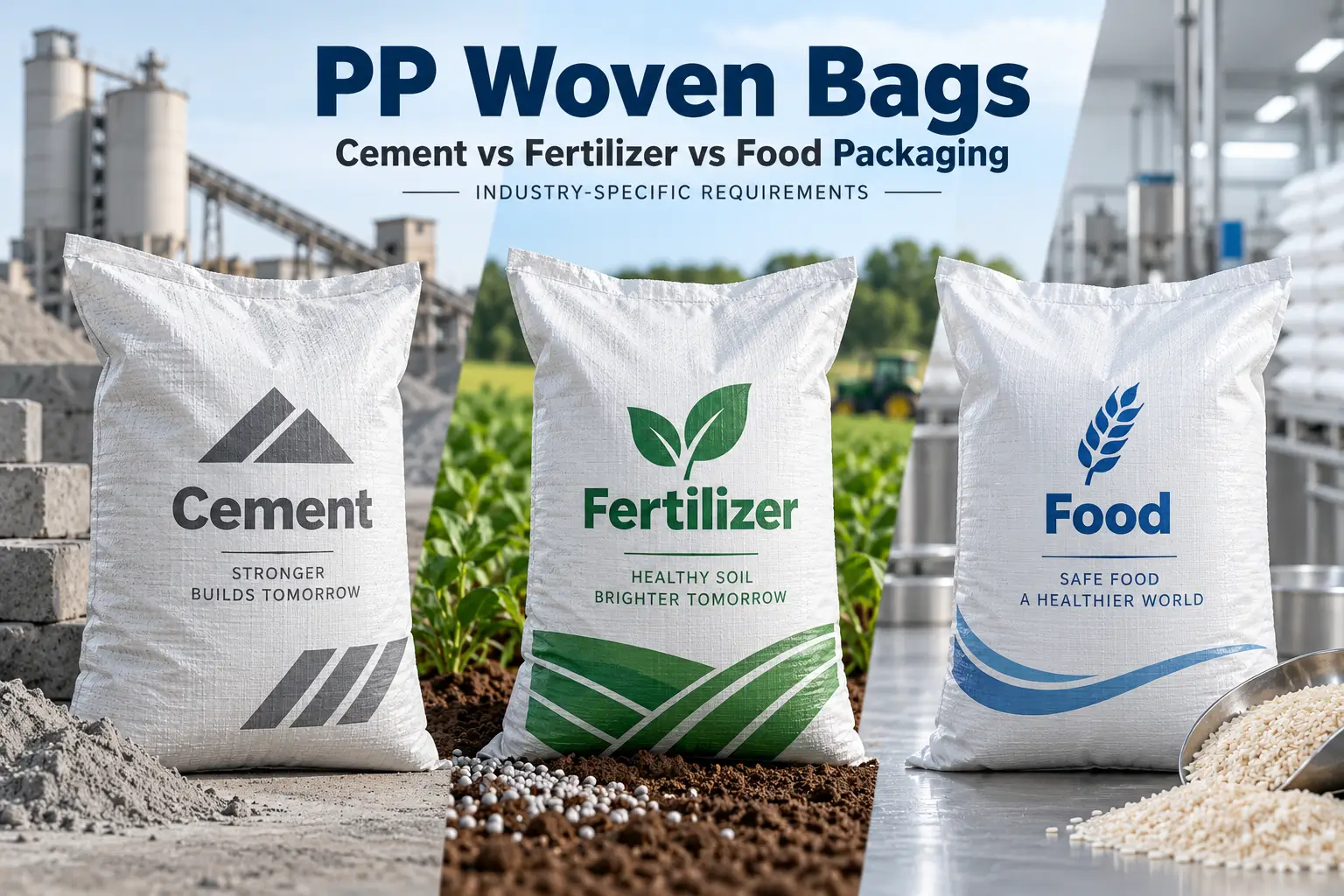
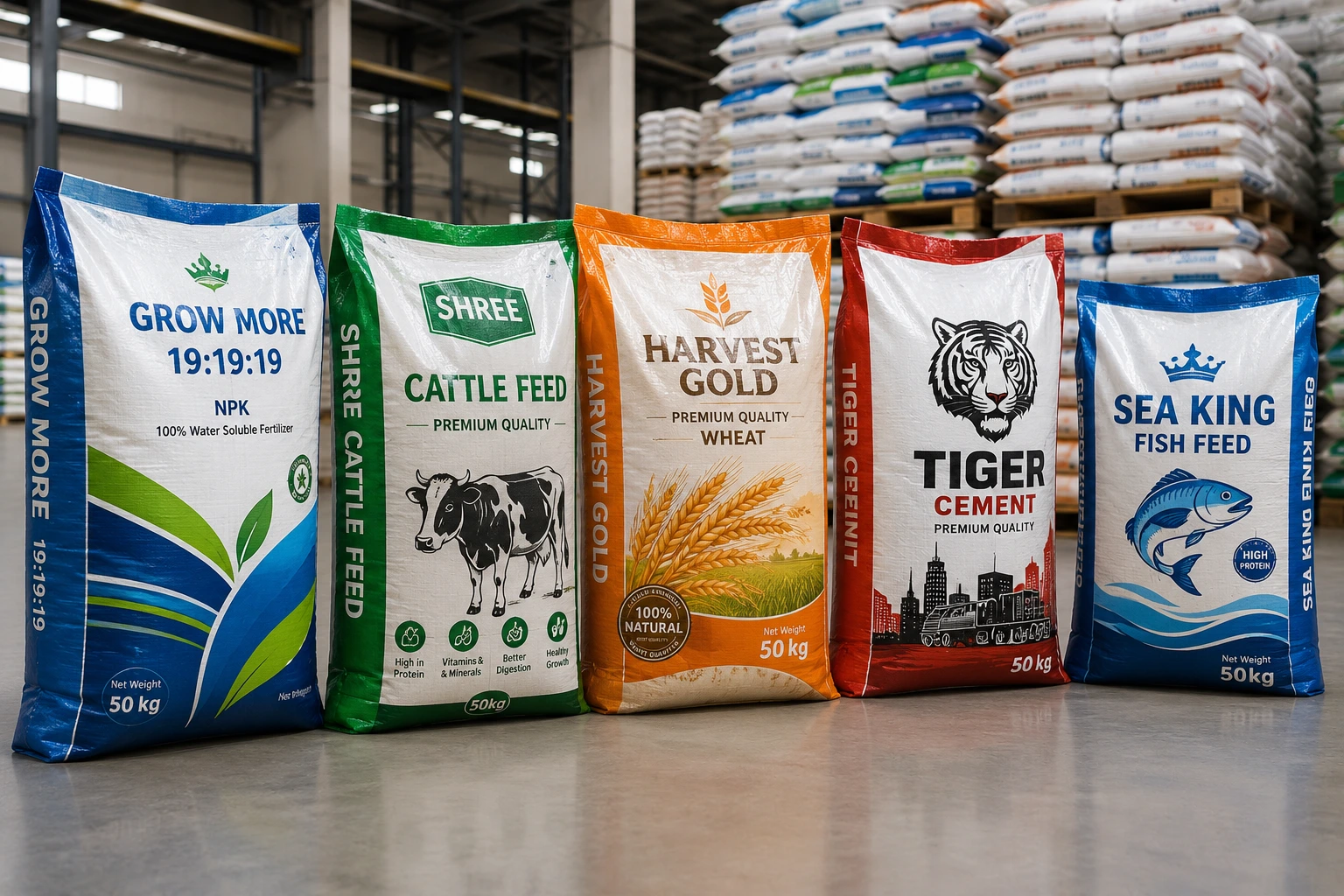
Walk into any busy wholesale market in India – Azadpur Mandi in Delhi, APMC in Mumbai, or Koyambedu in Chennai – and look at the bags stacked floor to ceiling. The ones that catch your eye first aren’t the plain white sacks. They’re the glossy, vivid, multicolour printed bags that instantly tell you what’s inside, who made it, and why you should trust it.
That’s the power of BOPP Woven Bags – and it’s why more Indian brands, manufacturers, and exporters are making the switch in 2026.
BOPP Woven Bags – short for Biaxially Oriented Polypropylene laminated woven bags – combine the rugged load-bearing strength of PP woven fabric with a high-gloss laminate surface that enables near-photographic print quality. The result is packaging that doesn’t just protect your product; it actively sells it. If you’re an Indian brand thinking seriously about how your packaging can work harder for your business, our guide to BOPP laminated woven bags is a great place to start understanding what’s possible.
India’s flexible packaging industry is projected to reach ₹1.12 lakh crore by 2026, and within this growing market, BOPP laminated woven bags are one of the fastest-growing segments – driven by demand from food processing, agri-exports, chemicals, and FMCG brands that understand the commercial value of premium packaging. In this article, we break down everything Indian brands need to know: what makes BOPP woven bags different, how multicolour printing actually works, what it costs, and how to choose the right manufacturing partner.
Table of Contents
ToggleWhat Are BOPP Woven Bags and How Are They Different from Regular PP Woven Bags?
BOPP Woven Bags are a step up from standard PP woven packaging – and once you understand what goes into them, it’s easy to see why they command a premium and deliver better commercial outcomes for brands.
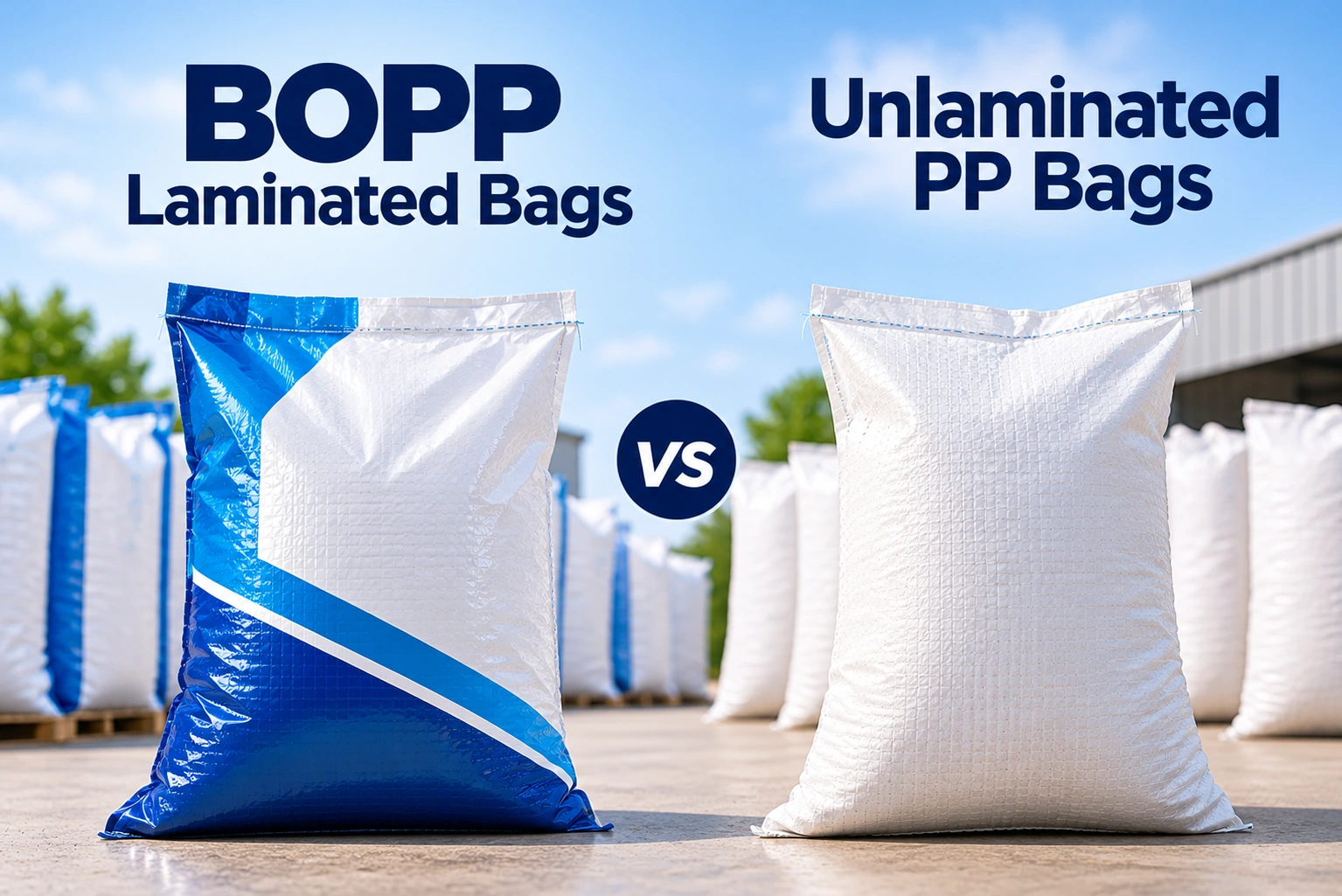
A standard PP woven bag is made from woven polypropylene tape strips – strong, reliable, and functional. But its surface is rough and fibrous, which means print quality is limited. Colours can appear dull, fine design details get lost, and the overall look rarely conveys premium quality.
A BOPP Woven Bag solves this problem by bonding a BOPP (Biaxially Oriented Polypropylene) film onto the surface of the PP woven fabric through a lamination process. This film creates a smooth, glossy surface that holds ink beautifully – enabling sharp text, vivid colours, photographic imagery, and fine brand details that simply aren’t achievable on unlaminated woven bags.
The key differences that matter for Indian brands:
- Print quality: BOPP laminated bags support up to 8-colour flexographic or rotogravure printing with colour accuracy that rivals premium paper or plastic packaging.
- Moisture resistance: The BOPP laminate provides an additional moisture barrier, making these bags ideal for food products, hygroscopic powders, and products stored in humid environments.
- Visual impact: The high-gloss surface creates a premium shelf presence that significantly outperforms matte or unlaminated alternatives in retail and distributor environments.
- Structural strength: Despite the added laminate, BOPP woven bags retain the full load-bearing strength of PP woven fabric, typically handling 10 kg to 50 kg per bag depending on GSM specification.
- Brand differentiation: In commodity markets where products are similar, the bag’s appearance becomes a primary differentiator – and BOPP bags make that differentiation unmistakable.
| What is a BOPP woven bag? A BOPP woven bag is a PP woven bag with a Biaxially Oriented Polypropylene (BOPP) film laminated onto its surface. This lamination creates a smooth, glossy, moisture-resistant surface that enables high-quality multicolour printing. BOPP woven bags are widely used in India for rice, flour, sugar, spices, chemicals, animal feed, and other bulk commodities where brand presentation and product protection are both important. |
Why Are Indian Brands Choosing BOPP Woven Bags for Packaging in 2026?
BOPP Woven Bags aren’t new – but the reasons Indian brands are choosing them have changed significantly. It’s not just about looking good anymore. In 2026, this packaging format is being chosen for very specific strategic reasons.
Export Markets Are Demanding Better Packaging
India exported agricultural commodities worth over ₹4.5 lakh crore in FY2025-26, with rice, spices, pulses, and processed food making up a significant share. Buyers in the UAE, USA, UK, Germany, and Southeast Asia aren’t just evaluating your product – they’re evaluating your entire presentation. A poorly printed or visually weak bag can be the difference between winning and losing an export contract.
BOPP woven bags meet the visual and functional expectations of premium international buyers. They accept full regulatory text, ingredient lists, certification logos, and barcode or QR printing with clarity – all of which global buyers increasingly expect as standard.
Retail Channels Are More Competitive Than Ever
Modern trade in India – organised retail, supermarkets, and e-commerce fulfilment – has raised the bar on packaging significantly. When your product sits on a shelf next to three competitors, the bag that looks premium, clean, and well-branded will outsell the one that doesn’t. It’s that straightforward.
According to Aeroflex Neu’s 2026 India market insights, businesses that upgraded to BOPP laminated woven bags saw measurable improvements in distributor and retail pickup rates within the first season of switching – particularly in the rice milling, spice processing, and flour manufacturing segments.
Brand Building Is Now a Supply Chain Priority
India’s B2B landscape is maturing rapidly. Businesses aren’t just selling products anymore – they’re building brands that command loyalty and price premiums across their distribution networks. BOPP woven bags are one of the most cost-effective ways to extend brand identity all the way down the supply chain, from manufacturer to end buyer.
When every bag that leaves your facility carries your brand consistently and beautifully, you’re doing brand building at scale – at a cost per impression that no other marketing medium can match.
| Are BOPP woven bags suitable for food packaging in India? Yes. BOPP woven bags are widely used for food packaging in India for products including rice, flour, sugar, spices, pulses, and animal feed. Food-grade BOPP woven bags are manufactured using virgin polypropylene resin and comply with FSSAI regulations. The BOPP laminate provides additional moisture resistance, keeping food products fresh during storage and transit. Always confirm food-grade certification with your manufacturer. |
How Does Multicolour Printing on BOPP Woven Bags Actually Work?
BOPP Woven Bags get their stunning visual output from a printing process that’s more sophisticated than most buyers realise. Understanding how it works helps you make better decisions about your artwork, colour selection, and order specifications.
Flexographic Printing – The Industry Standard
Most BOPP woven bags in India are printed using flexographic printing – a high-speed rotary printing method that uses flexible polymer plates to transfer ink onto the BOPP film surface. Modern flexographic presses can print up to 8 colours simultaneously, with registration accuracy tight enough to reproduce fine logos, small text, and photographic gradients consistently across large production runs.
Flexographic printing is cost-effective at scale, making it the go-to choice for bulk orders of 10,000 bags and above. The combination of speed, colour range, and consistency at volume is difficult to match with any other printing method.
Rotogravure Printing – For Maximum Precision
For brands requiring the absolute highest print quality – think photographic product imagery, very fine typography, or precise colour matching for international brand guidelines – rotogravure printing is the premium alternative. Rotogravure uses engraved cylinders to transfer ink, producing sharper edges and more consistent colour density than flexo, particularly for fine detail at very small sizes.
Rotogravure involves higher setup costs (cylinder engraving is more expensive than flexo plate making), so it’s typically reserved for very large production runs or brands where print quality is a non-negotiable commercial requirement.
What Goes Into Getting the Print Right?
Great multicolour printing on BOPP woven bags isn’t just about choosing a printing method. Several factors determine the final output quality:
- Artwork resolution: Supply artwork at minimum 300 DPI for photographs and fine detail, and use vector formats (AI, EPS, PDF) for logos and text to ensure they scale without quality loss.
- Colour specification: Always specify colours in Pantone or CMYK references rather than RGB – screen colours look different from printed colours, and CMYK/Pantone references ensure consistency between proof and production.
- Film thickness: The gauge (thickness) of the BOPP laminate affects how well the surface holds ink and the overall visual quality. Thicker films generally produce better print adhesion and gloss levels.
- Ink quality: UV-resistant inks are recommended for bags that will be stored outdoors or in sun-exposed logistics environments, preventing fading during extended storage or transport.
- Print proof approval: Always approve a physical printed proof or a calibrated digital proof before committing to a full production run – colour can vary between monitor displays and actual printed output.
| How many colours can be printed on a BOPP woven bag? Modern BOPP woven bag printing supports up to 8 colours using flexographic or rotogravure printing. Most standard brand designs work comfortably within 4 to 6 colours. The number of print colours affects tooling and setup costs, so working with your manufacturer to optimise the design within a practical colour count helps control per-bag costs without compromising brand impact. |
What Does It Cost to Get BOPP Woven Bags Custom Printed in India in 2026?
BOPP Woven Bags cost more than plain PP woven bags – that’s the honest answer. But the question isn’t whether they cost more; it’s whether the return justifies the investment. For most Indian brands in food, FMCG, agri-exports, and chemicals, the answer is clearly yes.
Here’s a realistic breakdown of 2026 pricing for custom printed BOPP woven bags in the Indian market:
- Standard PP woven bag (no lamination, 1-2 colour print): ₹18 to ₹32 per bag at bulk order quantities.
- BOPP laminated woven bag (2-colour print, standard GSM): ₹38 to ₹52 per bag for orders above 10,000 units.
- BOPP laminated woven bag (4-colour multicolour print): ₹48 to ₹68 per bag depending on bag size and GSM specification.
- Premium BOPP laminated bags (6-8 colour, rotogravure, food-grade): ₹65 to ₹95 per bag for large-volume orders with certification requirements.
- FIBC jumbo BOPP bags for export bulk commodity packaging: ₹280 to ₹650 per bag depending on lifting capacity and print complexity.
For international export orders, freight costs add approximately ₹8 to ₹22 per bag depending on destination, Incoterms, and container type – though most Indian exporters factor this into their ex-works pricing structure.
The per-bag cost of BOPP lamination and multicolour printing is typically ₹6 to ₹18 above an equivalent plain woven bag. For a 25 kg rice pack selling at ₹1,400 to ₹2,200 per bag at wholesale, that incremental cost is less than 1% of product value – while the brand impact and market differentiation it delivers can be significant.
| What is the minimum order quantity for BOPP woven bags in India? Minimum order quantities for custom printed BOPP woven bags in India typically range from 5,000 to 10,000 units, depending on the manufacturer and print complexity. At Aeroflex Neu, we work with clients across a range of order sizes and can provide guidance on the most cost-effective order structure for your specific requirements. Larger orders above 50,000 units typically qualify for better per-unit pricing and priority production scheduling. |
How Does Aeroflex Neu Deliver High-Quality Multicolour Printed BOPP Woven Bags?
At Aeroflex Neu, we manufacture BOPP laminated woven bags at our production facility in Udaipur, Rajasthan – one of India’s most established PP woven packaging manufacturing regions. Our end-to-end production capability means we control every stage of the process, from PP tape extrusion and weaving to lamination, printing, cutting, and stitching.
Here’s what goes into every order we produce:
Material Quality from the Start
We use virgin polypropylene resin and high-grade BOPP film in our laminated bags. Every raw material batch is tested for tensile strength, melt flow index, and UV stabilisation before entering production. For food-grade orders, we maintain strict separation of material batches to ensure compliance with FSSAI requirements.
Printing That Stays True to Your Brand
Our flexographic printing units support up to 6 colours with tight colour registration and consistent output across large production runs. Before any production print begins, clients receive a physical print proof for approval – so what you approve is what gets produced, without surprises.
We work with clients on artwork preparation if needed, providing technical guidelines for resolution, colour mode, bleed settings, and safe zones to ensure the final printed bag looks exactly as intended.
Quality Control at Every Stage
Aeroflex Neu’s high-quality BOPP woven bags go through multiple inspection checkpoints during production – covering lamination adhesion, print registration, dimensional accuracy, seam strength, and load capacity. For export orders, we provide complete documentation including GSM certificates, lab test reports, and any compliance documentation required by the destination market.
Reliable Delivery for Bulk Orders
We understand that packaging procurement is tied to production schedules. Lead times for custom printed BOPP woven bags at Aeroflex Neu typically run 18 to 28 working days from artwork approval, depending on order volume and print complexity. We maintain transparency on production timelines and provide updates at key milestones so your procurement team can plan with confidence.
| How long do BOPP woven bags last in storage? BOPP woven bags, when stored correctly in covered, dry conditions away from direct sunlight, typically maintain their structural and print integrity for 18 to 24 months. For outdoor storage or sun-exposed logistics environments, bags manufactured with UV stabiliser additives in the PP fabric extend usable life significantly. The BOPP laminate itself also provides an additional layer of protection against humidity and moisture ingress. |
Which Indian Industries Should Be Using BOPP Woven Bags Right Now?
BOPP Woven Bags aren’t suited to every application – but for several major Indian industries, they represent the strongest available packaging option in 2026. Here’s where the case for switching is most compelling:
Rice Mills and Agri-Exporters
India remained the world’s largest rice exporter in FY2025-26, with shipments exceeding 21 million metric tonnes. In the competitive global rice trade, where buyers in Africa, the Middle East, and Europe are choosing between suppliers from India, Thailand, Vietnam, and Pakistan, packaging presentation is a genuine competitive factor. BOPP woven bags with vibrant multicolour printing, variety and grade labelling, and FSSAI or organic certification logos are now effectively standard among premium Indian rice exporters.
Flour and Spice Manufacturers
For flour mills and spice processors supplying organised retail and modern trade channels in India and abroad, BOPP laminated bags provide the surface quality needed for detailed nutritional panels, recipe suggestions, barcode printing, and full-colour brand imagery. These aren’t extras – they’re increasingly required by retail buyers as a condition of listing.
Animal Feed and Aquaculture
Animal feed manufacturers are one of the fastest-growing user segments for BOPP woven bags in India. The ability to print detailed feeding instructions, species-specific product information, and vivid imagery of livestock and aquaculture species on a premium surface has made BOPP laminated bags the preferred choice for brands positioning themselves in the premium veterinary and aquaculture feed market.
Chemical and Mineral Manufacturers
For industrial chemicals, pigments, and mineral powders where the end buyer is a business rather than a consumer, BOPP woven bags deliver the dual benefit of clear hazard and handling information printing alongside professional brand presentation – both of which matter in B2B procurement decisions.
| Can BOPP woven bags be made sustainable or eco-friendly? BOPP woven bags can be manufactured with recycled polypropylene content (rPP) and designed for end-of-life recyclability. While multi-layer laminated bags are more complex to recycle than single-material alternatives, advances in mono-material BOPP laminate technology in 2025-26 are improving recyclability. Indian manufacturers are increasingly offering eco-certified options to help exporters comply with EU sustainability regulations and meet the requirements of environmentally conscious global buyers. |
Final Thoughts: Better Bags Mean Better Business
Packaging decisions don’t happen in a vacuum. When you choose to invest in high-quality multicolour printed BOPP Woven Bags, you’re making a decision that ripples through your entire commercial operation – from how distributors perceive your brand, to how export buyers evaluate your products, to how your bags look on the shelves of retail chains across India and overseas markets.
The businesses that are winning in India’s competitive manufacturing and export landscape in 2026 aren’t leaving packaging to chance. They’re choosing formats like BOPP laminated woven bags because they understand that packaging is both a functional requirement and a brand investment – and the returns on that investment show up in reorder rates, distributor relationships, and market positioning.
If you’re ready to explore what premium BOPP printed packaging can do for your brand, Aeroflex Neu Limited is here to help. From artwork guidance to bulk production and export documentation, we handle the full process so you can focus on your core business.
Visit our BOPP laminated woven bags product page to explore specifications, request a sample, or get a customised bulk quotation. Let’s build something your buyers won’t forget.
Frequently Asked Questions
Q1. What is the difference between BOPP woven bags and regular PP woven bags?
Regular PP woven bags are made from woven polypropylene tape and have a rough surface that limits print quality to basic text and simple designs. BOPP woven bags have a Biaxially Oriented Polypropylene film laminated onto the surface, creating a smooth, glossy finish that supports high-quality multicolour printing, photographic imagery, and fine brand details. BOPP bags also offer better moisture resistance and a significantly more premium visual presentation.
Q2. Are BOPP woven bags strong enough for heavy products like rice or cement?
Yes. The BOPP lamination adds visual quality without reducing the structural strength of the underlying PP woven fabric. BOPP woven bags are commonly used for 10 kg, 25 kg, and 50 kg fills of rice, flour, sugar, fertilisers, chemicals, and construction materials. The woven construction provides high tensile and burst strength, and seam quality is maintained through the same stitching and heat-sealing processes used in standard PP woven bags.
Q3. How do I prepare artwork for custom printed BOPP woven bags?
Provide artwork in vector format (AI, EPS, or PDF) for logos and text to ensure scalability without quality loss. For photographic or complex imagery, supply files at a minimum of 300 DPI. Specify all colours in CMYK or Pantone references rather than RGB. Include bleed areas of at least 5 mm around the print area. Your manufacturer should provide a technical brief with exact specifications before you finalise artwork – always request this before submitting files.
Q4. Can BOPP woven bags be used for export from India?
Absolutely. BOPP woven bags are one of the most export-ready packaging formats available to Indian manufacturers. They support full regulatory and compliance text printing, are classified under HS Code 6305 for customs purposes, and are accepted by buyers across the EU, USA, Middle East, Africa, and Asia-Pacific. Many Indian exporters find that BOPP laminated bags help them meet both the visual expectations and compliance requirements of international buyers more effectively than other packaging formats.
Q5. How do I choose the right GSM for BOPP woven bags?
GSM (grams per square metre) determines the strength and weight of the woven fabric in the bag. For lighter products (10-15 kg), a base fabric of 60-80 GSM is typically sufficient. For heavier commodities (25-50 kg), 90-120 GSM fabric is recommended. For export orders involving rough handling at ports, the higher end of the GSM range is advisable. Your manufacturer can recommend the right GSM specification based on your product weight, filling method, and handling conditions.
Q6. How do I place a bulk order for BOPP woven bags with Aeroflex Neu?
Visit aeroflexneu.com/bopp-laminated-woven-bags and share your requirements – bag dimensions, GSM, print colours, order quantity, and delivery timeline. Our team typically responds with a detailed quotation within 48 business hours. We provide a print proof for your approval before production begins, and we offer complete export documentation for international orders. Both domestic and export orders are welcome.